When should the phrase “We are doing some boat jobs” actually be “We are doing a refit”?
We arrived in Whangarei, New Zealand last November, very excited to have lots of great marine services available. Over our time in Tonga, we put together a spreadsheet of all the things we could think of that we might like to do to the boat. Essentially, it was a wish list based on our five years of cruising Mexico, French Polynesia, and across to Tonga.
The list was 44 items long and each one had sub-tasks to accomplish it. Some were not important, some were simple, some were big and expensive. We prioritized them. We made wild guesses at the cost. While in Tonga, we reached out to New Zealand trades, made some plans, initiated some purchases, and made a commitment to be in the Future Classics boat shed at Riverside Drive Marina in mid-November.
The biggest item on our list was to remove the original teak decks and put down some other kind of non-skid surface – the exact kind was still to be determined. We felt this task was the one that would determine our time in the boatyard and we wanted to start before the long Christmas break that occurs in New Zealand. Ideally, we would complete the jobs that we needed trades for before they all disappeared on holiday. We would then finish our tasks in the quiet boatyard to be ready to splash again at the end of January. We were so naïve.
Work started quickly. We arrived in Whangarei on November 5th after a nice 10-day passage from Tonga that included a fun stop at Minerva Reef. We cleared into the country at Marsden Cove. The following day, we proceeded 10nm upriver to Riverside Drive Marina, where, unbeknownst to us, we would spend the next six months. After a weekend trip to Auckland to see our crew off home, we returned to the boat to prepare.
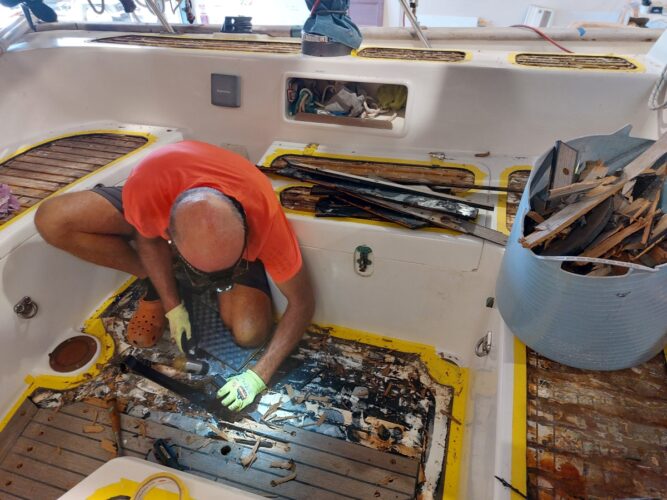
As soon as we were in the shed, work started to remove fittings from the deck. The teak itself was in good shape but water was getting underneath it and finding its way into the boat.
Our plan is to spend two cyclone seasons in New Zealand, going to Fiji in between. We also plan to do some land travel. We easily purchased a used car, which was a tremendous help with all the boat jobs and was our means of five weeks travel on the north and south islands of New Zealand. We also needed somewhere to store items removed from the boat. Renting a nearby storage locker was simple, and it was quickly filled with more stuff than can be imagined. We wouldn’t be able to live on the boat while it was in the work shed so we rented an apartment nearby for four weeks. On November 15th the boat came out of the water, the mast was removed, and the boat went in the shed. We immediately started removing everything that was mounted on top of the teak. Patrick Moreton, the owner and shipwright of Future Classics, and his worker John, made templates of the decks. With the two of us working beside Patrick and John, all the old teak was removed in three days. We were pleasantly surprised by the condition of the deck below the old teak. We saw evidence of a lack of sealant around many of the edges of the teak, which confirmed our supposition that this was a source of water ingress around deck penetrations, particularly those close to the edges of the teak.
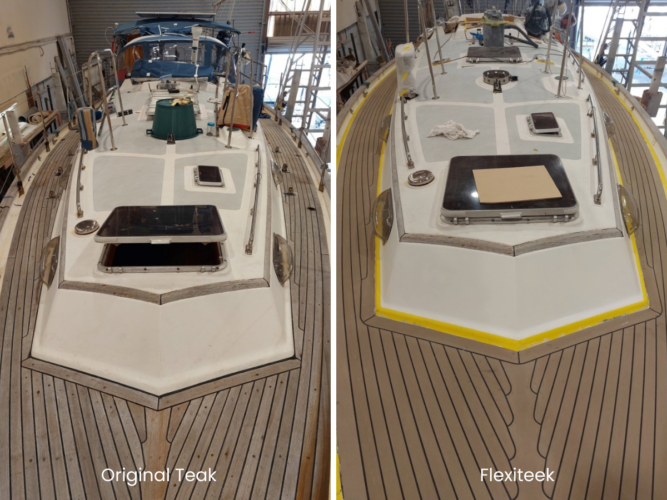
The original teak deck compared with the new Flexiteek.
At the suggestion of Patrick, we chose to put down Flexiteek, a synthetic product that has good reviews and looks surprisingly close to real teak. It comes in a number of shades including one called ‘Weathered’, which we picked because it was close to the colour of the teak cap rail. We’ve been quite happy with the product so far. It is obvious it is not real teak, but it is not so obvious that it is plastic either. We understand that high end boat builders are using it in preference to the poor-quality real teak supplied today.
Preparation of the deck required sanding the old sealant off; countersinking the old screw holes before filling with epoxy; cleaning, sanding, and polishing the outer edges of the deck beyond where the teak lay; and painting. There was also fibreglass work to be done at the bow, some due to leaks around the pulpit bases that had caused the embedded mild steel backing plates to rust and heave, some to move the location of the windlass further back to increase the room for the chain stacking. The only other significant fibreglass work was to remove the prism from over the navigation table. We liked the prism, it didn’t leak, but if it ever did we would kick ourselves for leaving it in the deck.

The teak in the cockpit was recessed in the deck. It appears that it was placed into wet resin that formed a lattice work. It was tedious removing this and leveling the bottom of the insets.
The templates went off to the Flexiteek supplier for manufacturing while the four of us worked to prepare the decks. When removing the teak from the cockpit we discovered it was laid into a latticework of resin. Apparently wet resin was poured into insets in the cockpit and the teak panels pressed in. All this remaining lattice needed to be removed, and the insets built up to accommodate the thinner Flexiteek. This was time consuming, messy, and the first delay in progress.

The actual process of gluing the Flexiteek down was fast. A section of mastic was put down; the decking placed on it; Patrick and John went over it with a metal roller to remove all air; panels and weights were placed on. It was then left for three days to cure.
When our grunt work was not necessary on the deck we tackled other items on our list. The main one we wanted to do while not living on the boat was to replace all eleven through-hulls. It was a good job to do when the interior was largely empty. We were puzzled by water in the bilge a couple of days after removing the old through-hulls as the boat was in the shed and the bilge had been dry.
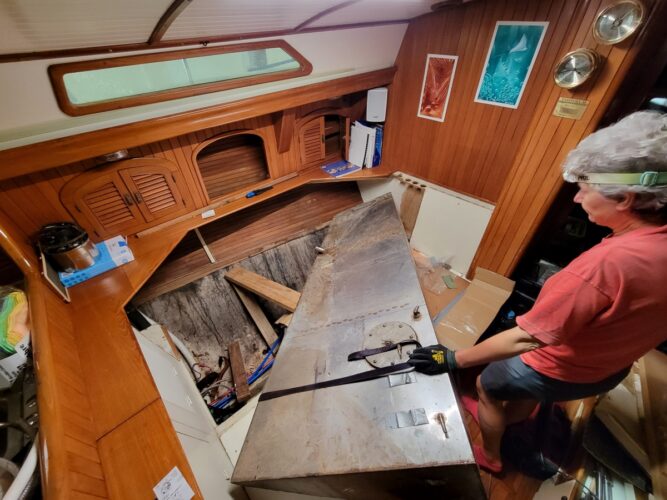
It was quickly apparent that the water tank would not fit out the companionway without being cut down.
Investigating the source led to the discovery of a leaking freshwater tank. Replacing the original stainless steel water tanks was on the list as a very low priority item, which we did not really intend to do. It was on the list because we knew the welds were very rusty inside the tank and we’ve had to clean the tanks in the past to remove this rust. We knew something would need to be done at some point, we just didn’t think we needed to do it now. We decided to remove both tanks and replace them with custom polypropylene tanks that will certainly outlast everything else on the boat. Removing the tanks meant disassembling the salon furniture and cutting the larger of the two tanks to get it out the companionway. The new tanks, however, would not be ready until the end of February.
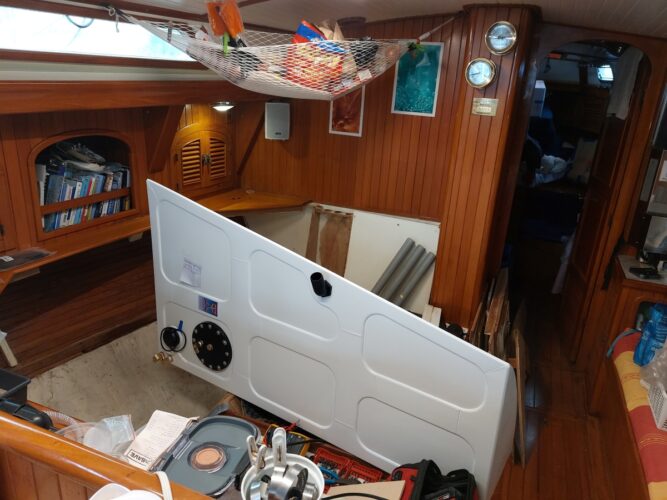
We replaced both the port and starboard water tanks with custom made polypropylene tanks. We made the port tank smaller so it would fit through the companionway. This had the advantage of leaving a space to install the new water maker, though at the loss of some tankage.
We were excited to find there was an Aquadrive dealer in Auckland as we wanted to get ours serviced. This is a combination thrust bearing and universal joint that decouples the driving force of the propellor from the engine mounts and accommodates small misalignment. We had no idea of the last time it had received any attention and it did occasionally rattle. This was a good time too, as the cutlass bearing needed to be replaced so the drive shaft was coming out anyway. While we are at it, there is also a Max-Prop shop in Auckland so we can get the propeller balanced and checked too. Good thing we took the Aquadrive in, it was well worn. Unfortunately, it is also obsolete, with no parts available. In the way of all boat things, the new model has different dimensions and a different coupler to the propeller shaft. More time, more dollars to install the replacement.
In December, Patrick pushed hard to complete the decks so we could move the boat out of the shed and return to living aboard. At some point, we realized that it would be much easier to keep the boat in the shed over the holidays. We still had to remove the water tanks so living aboard while trying to dismantle our living space was not appealing. We lucked into a nearby pet sitting opportunity that gave us a place to live for free over the holidays. Patrick was also happy as he could slow down.
In early January we decided that we could, and would, take a break to do some land travel. In particular we wanted to see the South Island of New Zealand and do some hiking. We booked a ferry to the South Island for February 23rd and a return ferry March 19th. We booked ourselves onto the Humpridge Track, one of New Zealand’s so called Great Walks. As a recent addition, it is affectionately known as number eleven of the ten Great Walks.
We moved out of the shed late January. It was good to move back aboard, even if it was still on the hard. We had reassembled the salon, despite not having any water tanks at that point. We hooked up directly to the marina water supply, with a pressure reducer, in order to have water on board.
The next big item on our list was to strip all the old bottom paint off. This was really overdue as the old paint was flaking off in chunks. After several conversations with the boatyard painter, we opted to hire him and his crew to strip the bottom back to gelcoat. As Simon the painter said to us: “If people are going to hire us to either scrape or paint, they generally choose to have us scrape. We don’t like it either but at least we get paid to do it.” Clever guy. There were a few osmotic blisters evident that they would fix too.
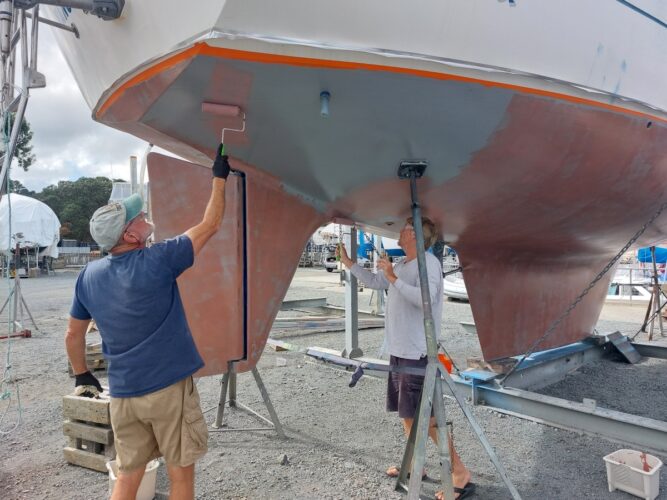
Applying Coppercoat is an all-day affair as multiple layers of epoxy laden with copper powder are applied wet-on-tacky. Anne mixed batches all day while Ken and Dean applied. Dean had done his boat earlier and kindly offered to help us.
We had grown tired of cleaning the bottom and feeling guilty watching our ablative antifoul float away. We wanted to change paint systems but needed a fresh bottom to do this. After lots of research we decided to go with Coppercoat. A system of embedding copper powder in epoxy and then lightly abrading it to expose the copper. It is said to last 10 years with minor maintenance. The bottom still needs to be cleaned, but at least the paint doesn’t float away when doing so.
We left Simon and his crew to finish scraping the bottom while we headed south with our rooftop tent to explore New Zealand by land. A week later we got a call from Simon that there were a lot more blisters than initially detected. Several hundred in fact. Not deep and not large, just plentiful. He remarked that it was still significantly more cost effective to fix the individual blisters rather than peel the hull. We asked for an estimate, knowing that we would tell him to go ahead, but wanting the shock now not later. When we returned a month later the bottom was nearly all repaired and would soon be ready for barrier coat and Coppercoat. Another month elapsed before all the other work was complete and we were back in the water.
In the end we did more of the jobs on the list than we expected or intended, and some that were not even on the list. Some were opportunistic – everything else was torn apart so access was easy – and some were eye candy to enjoy later, like refinishing the cockpit table.
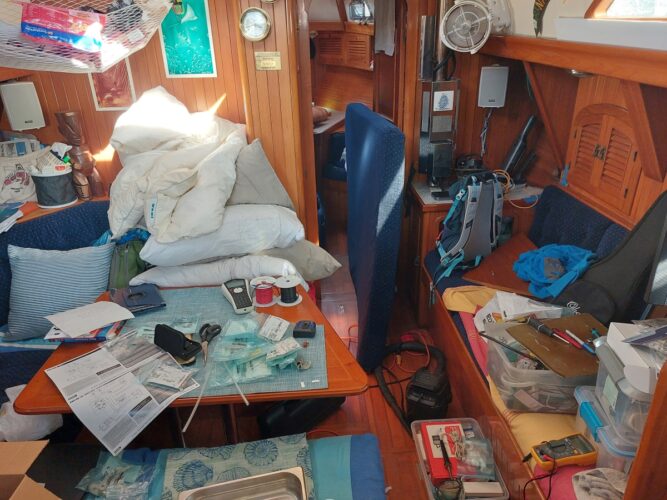
It was definitely less fun doing some boat jobs while living on the boat. Tools and supplies came out in the morning and had to find a home later in the day so we could eat and sleep somewhere.
In the end we replaced the teak decks with Flexiteek, installed a new windlass with directional control and a wireless remote, replaced the anchor chain, replaced the standing rigging, put the staysail on a furler, replaced the backstay chainplate, removed and modified the bow fitting to better accommodate our oversize Spade anchor, replaced the water tanks, replaced all through-hulls, replaced the exhaust hose and gooseneck, installed a new water maker, applied Coppercoat, replaced the cutlass bearing, prop shaft, and Aquadrive, balanced the Max-prop, and many other things that keep the boat seaworthy. It was much more than we really thought we would do, and it cost more than we planned, but we also knew that would be the case.
It took some time to completely empty our storage locker and get everything stowed back aboard. We took a couple of trips down river to test some systems and managed to get at least a daysail in before departing for Fiji. Not really a proper shakedown, and who knows what we’ve messed up with all the work we’ve done. We are drafting this article while on passage and so far, no big surprises.
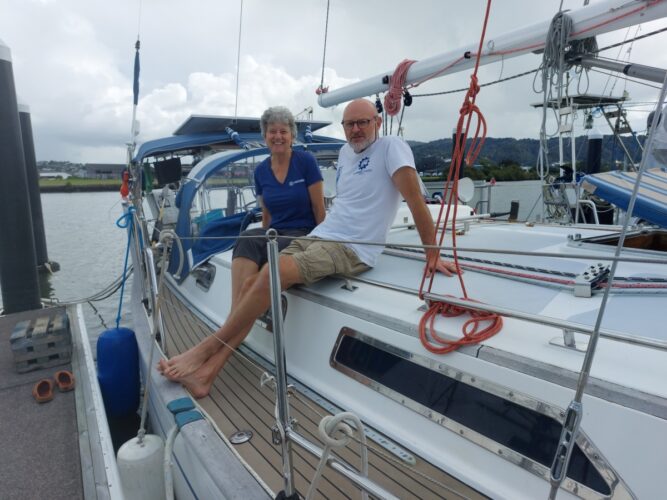
A happy couple back in the water. It sure felt good to be floating again with only a few tasks remaining.
We have been very happy with all the suppliers and trades we interacted with in New Zealand. In hindsight, it was clearly a refit, and we should have known that by the scope of work we contemplated. We did something to every aspect of the boat: safety, sailability, liveability, and appearance. Sure, there is more we’d like to do, but we’ll be back next year!
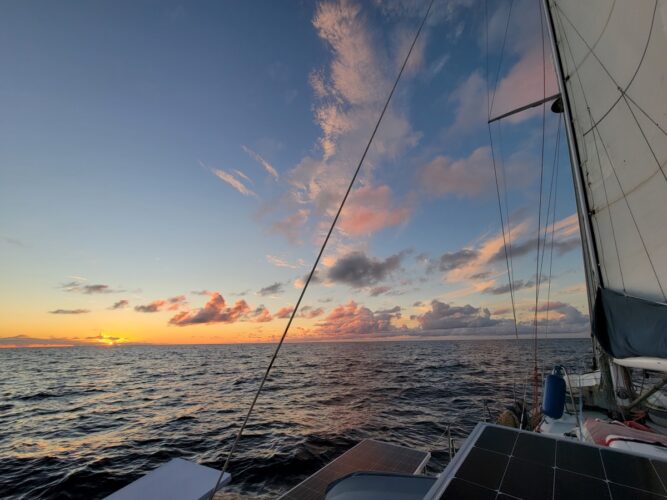
A beautiful evening sky as we sail up to Fiji to enjoy the tropics.