I’ve written this for the benefit of anyone planning to clear into Mexico with their boat and wondering what they need to do before leaving Canada, and what it might look like once they arrive in the country. It’s an account of our experience clearing in after sailing directly from Canada to Ensenada, where we then used the marina staff to assist with our customs and immigration process. It might not be exactly what you will experience, but you might find a nugget or two that will help reduce the paperwork anxiety, or prevent a snag at the immigration office.
The Clearing In Process
Documentation needed:
- Passports
- Boat registration
- Insurance that specifically states coverage in Mexico
- Recent photo of boat
- Recent survey
- Proof of ownership of tender
- Serial number for inboard engine(s)
- Serial number for outboard engine(s)
Office staff at Cruiseport Village Marina in Ensenada will assist you with clearing both the humans and the vessel into the country. We sat down with Octavio, whom we had contacted before we arrived. We made our reservations in August, not knowing when we’d arrive. To make the reservations, Octavio asked for copies of our passports, our insurance showing that we had insurance in Mexico specifically (we had to contact our insurance company to get the wording just right), a recent photo, and our last survey.
The TIP
Before arriving in Ensenada, we had a lot of confusing and conflicting information. Let me talk first about the TIP.
Mexico requires every foreign boat and vehicle to have a permit allowing it to be in the country without paying import taxes. They do this to prevent yachts being sold on the black market, and to ensure that the proper taxes are paid. This permit is called a Temporary Import Permit, or TIP. A vehicle’s TIP is good for about 6 months, but a boat’s TIP is good for 5 years and is renewable. The TIP is connected to the vessel’s Hull Information Number (HIN). Boats older than 1972 will not have a HIN. Don’t ask me what they do in those cases.
A boat with a valid TIP is allowed to come and go from Mexico as many times as you want in that 10-year period without having to get a new permit. However, because the TIP is connected to the boat’s HIN, not the human owner, if the previous owner had a TIP and sold the boat without cancelling it, when you bring the boat in, the paperwork will have conflicting information and that’s not a good thing to have in a customs office. In my past personal experience, it’s excruciatingly painful. The penalty for entering Mexico with an outstanding TIP can be anything from denial of a new TIP, denial of a Zarpe (an exit document when you leave Mexico), to having the boat impounded, or worst case, seized forever.
Our boat, Salt, was built in Florida in 1998, purchased at some point by someone in California, sold to someone in Canada, and then sold to us. We’ve owned her for 6.5 years. This told us that A) since it once lived close to Mexico, there was a good chance there was a TIP on it at some point, B) the TIP was not necessarily going to show up in the digital database since the database only goes back to 2005. If the boat had a TIP before that, it could be on actual paper and would need to be checked by hand.
I wondered if the check would automatically be done when we ordered our new TIP, but of course it doesn’t work that way. The system does automatically check for old TIPs before issuing new ones, but they don’t do the hand-check. And, if you accidentally end up with two TIPs, you will be sooo flagged and life will be miserable for you.
I wondered if the marina could do this manual check for me, but no, they couldn’t.
For boats younger than 2005, go to the Banjercito [1] website and run a check for an outstanding TIP.* The Banjercito is short for Banco Nacional del Ejército, Fuerza Aérea y Armada. It operates as a commercial and development bank for members of the Mexican Army, Air Force, and Navy. It is the sole agency authorized to issue, track, and process TIPs for all foreign vehicles and vessels entering Mexico. If you find an outstanding TIP, you must have it cancelled. That will involve some hoops and take about a month, so don’t leave this until the last minute. If your boat is 2005 or older, keep digging.
We used a company called Clip [2] to run a physical check. It cost us 54 USD to find out there was no outstanding TIP – a bargain for that peace of mind. Had there been a TIP, that company could have helped us deal with it – for a tidy sum, no doubt.
Okay, that TIP issue was sorted. Were we good to go? Not quite.
Proof of Ownership for the Tender
A few months before we left, we just happened to trip over a comment made by someone somewhere about needing to be able to prove ownership of your tender. Without that, the authorities are free to deny it entry, impound, or seize it. Yeah, these guys have a lot of power.
We bought our dinghy from the same people we bought Salt from, but the dinghy wasn’t included in the sale. We had to negotiate with them to buy it separately, but sadly it was long before I was wise to the world of yacht sales and international travel. I failed to acquire a Bill of Sale for the dinghy. Communication challenges with the previous owners meant we could not get one retroactively. As such, we took the Bill of Sale for the sailboat that showed the previous owners’ names, the confirmation email from the bank showing the transfer and acceptance of payment for the dinghy, and took it to a Notary Public where David swore an oath of ownership. Unfortunately, the Mexican authorities did not recognize this. We were free to leave the marina, but we could not get our TIP until the dinghy issue had been sorted. They gave us 72 hours (working days) before there were…consequences. Happily, we managed to get it sorted the following day and now had everything in order.
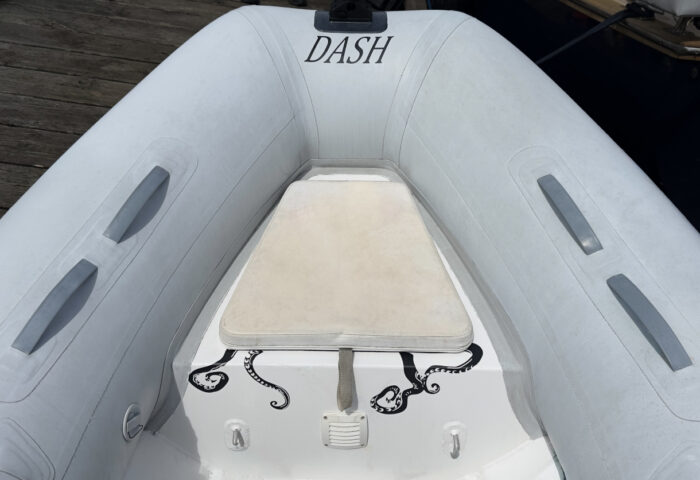
We were required to provide proof of ownership for the dinghy before we were granted a TIP.
Back to Clearing In
The process when we arrived at the marina was delightfully straightforward, and not even that time consuming compared to other experiences I’ve had at various borders. The staff at the marina are extremely experienced and efficient. It was clearly not their first rodeo. I had put all the documents I could think of into a binder and made six copies of everything. They didn’t need everything I had, but I had everything they needed. I didn’t need to make copies because they made their own. They notated some of them, knowing what the agents would ask.
It seems women’s lib hasn’t quite reached Mexico yet, however. David and I agreed that I’d be the “Captain” for the purposes of paperwork since I’m the one who handles the paperwork. In reality, we’re co-owners and co-captains. He has his jobs, I have mine, some we share. Octavio never asked and automatically built his own paperwork assuming David was the captain. It shocked me in the way one is shocked by getting slapped in the face with a live fish – but we rolled with it. We’re not in Canada anymore.
Everything was in order when Victor drove us to the immigration office. Since the day before was a holiday, the place was hopping. Dozens of people were lined up at four separate plexiglass-protected counters. There were a dozen mismatched chairs lined up and back-to-back in the middle of the grubby room. The floor was broken and dirty tile, boosting the cacophony of travellers and agents shouting at each other through plexi, and the screeching of packing tape getting rolled onto box after box. If I didn’t already have a headache from the two beers I had the night before, I would have gained one here. We sat while Victor stood in the line for us. When ready, we came to the counter where David, the male, signed papers and paid fees.
Money
Bring both a credit card and some US cash when you come. One of the fees could only be paid in cash, while the other two could only be paid by card.
Fees:
- 974.37 MXN for the TIP (credit card, about 80 CAD)
- 1,966 MXN for two people’s visas (180 days) (credit card, about 160 CAD)
- 416 MXN Port Captain fee for David and me (cash, 34 CAD for both of us)
As we didn’t have the pesos yet to pay the Port Captain’s fee, we had Victor stop at an ATM on the way to the immigration office. I converted US cash into pesos at 14.6% – or, 14.6 pesos to one US dollar. As of this writing, that’s a little high. It would have been better for me to have used my debit (not credit) card to take it out. We have Scotiabank accounts (debit and credit cards) that do not incur fees to exchange money from any other currency. It’s one of the main reasons we changed our banking to them a few years ago. Most banks charge a fee on top of the exchange rate. Right now, the bank would have given me about 17.29 pesos for a US dollar.
Okay, almost there.
Liability Insurance
We’ve heard from two very reliable sources that as we travel through Mexico, we must have liability insurance issued by a Mexican insurance company, that it’s not good enough to show liability in Mexico from your own non-Mexican company. As I understand it, this is kind of like the cost of paying a Mexican lawyer to make sure your Canadian insurer pays out. However, we don’t need it here in Ensenada, so I question the need for it. It seems like a cash-grab to me, so I looked up the so-called law that they’re citing to justify it. Given, I read the translation, but the legality of it didn’t really track, so I remain sceptical. However, legally required or not, if we want moorage and they require it, we’ll have to get it. When that day comes, I will use a company that was recommended to me by one of the above sources: Novamar. It will cost around 120-170 USD or 169-240 CAD and can be purchased online.
Going Forward
We’ve jumped through all the hoops and paid all the bills. Moving forward, when we leave this port and enter the next large one, we need to present our papers to the local Port Captain for a new stamp in, then another stamp when we leave, rinse and repeat. If we only anchor, we must call in on VHF 16 to let them know we’re there, but we don’t need to present the papers. We’re still allowed to land with our dinghy. When we want to leave the country, we must “check out” of the country by going into a customs office and getting a Zarpe (ZAR-pa). This is an important document because without it, you might not be allowed to enter some other countries, and you’ll have a heck of a time getting back into Mexico again, should you so desire. The northernmost customs office where you can get a Zarpe is here in Ensenada (not Tijuana). The southernmost office is Puerto Chiapas.
And that’s it! That’s all I got!
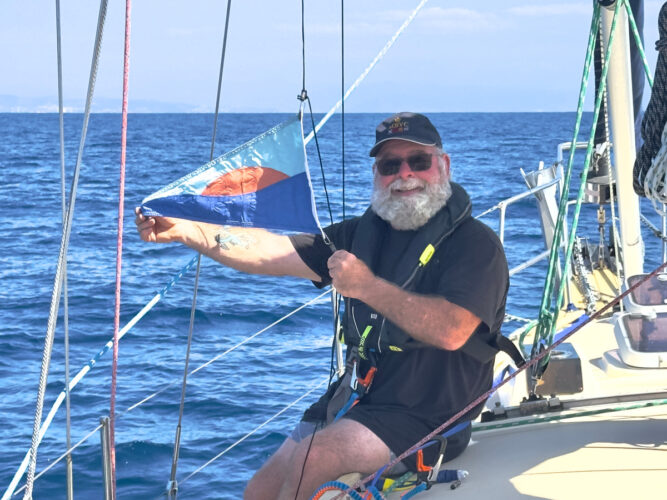
Former Commodore David gets ready to hoist the BCA burgee as Salt nears land.
Caveat – all I’ve written here is simply a representation of our own lived experience and what we’ve encountered or gleaned from the Internet. It may or may not apply to you, it might differ from port to port or day to day. It’s been a journey getting all this information together, so I hope it’s helpful to someone.
Happy travels and long may your big jib draw!
*Addendum: It has come to my attention that the Banjercito website does not look the same as it did when I wrote the article. After a bit more digging, it looks like the Mexican government has pulled public access to the raw database search due to severe automated scraping, data security changes, and scams involving stolen HIN numbers. You can do a work-around by beginning the process of applying for a TIP. The system will do a quick check during that process, but the problem there is that it can’t check on TIPs that haven’t been digitized.
The most reliable way of checking is to hire a company to investigate it for you, or email the Banjercito [3] department for submitting vehicle documents and copy to the Banjercito Temporary Vehicle Import System [4].