


Years ago in New Zealand we retired our old sewing machine and purchased a Swiss quilting machine. It has flexible space above the pressure foot and, by using heavier needles, I found I could fix sails and sew upholstery material on the machine.
It has served us well. When sails gave way offshore we made a temporary repair with sail tape and then fed the mended edge into the machine. I reinforced the edge of the sail tape with a zigzag stitch. As soon as possible, we would get a professional sail repair or a new sail. Sometimes we suffered from the cramped quarters inside or even having to effect the repair outside (see featured photo above). However, being able to make repairs has enabled us to travel to new destinations and to meet new people with relatively worry-free sailing.
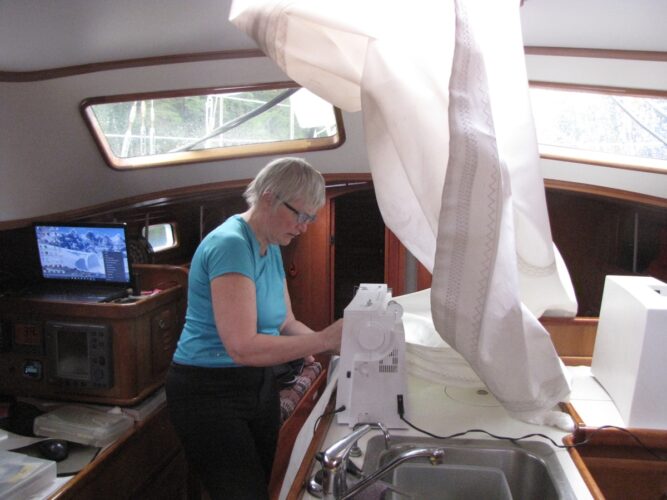
Sail sewing aboard in a small space
In Chilean Patagonia we repaired the sail in Caleta Suarez, Patagonia before sailing across the Pacific and getting new sails in New Zealand. The Chilean fishermen on the ‘Don Nestor’ became friends after we rafted to them.
In Norway, we repaired the sail in coastal Moskenesoy before getting a complete set of new sails in Ipswich, England. In Norway, Larry was reminded of his youth in Newfoundland with the drying codfish. We were amused by the novel sight of a bus headed to the town with the shortest name we have heard of: Å. Our Norwegian friends told us it’s actually the last letter of the Norwegian language – the alphabet runs from A to Å.
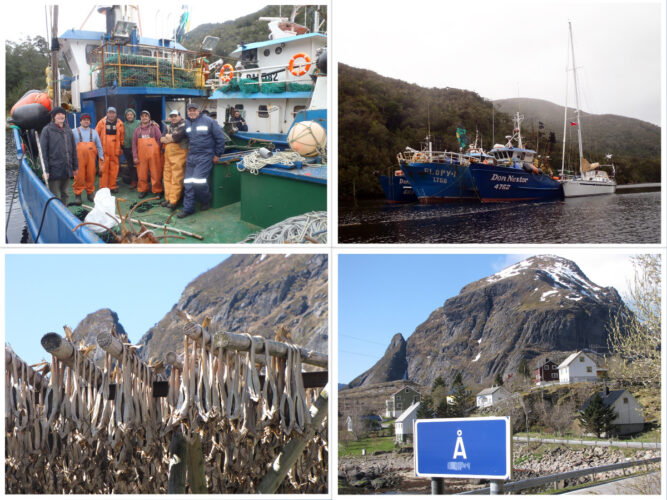
Top Left: Larry aboard the Don Nestor; Top Right: Rafted to fishboats in Caleta, Suarez Chile; Bottom Right: Codfish drying in Moskenesoy Norway; Bottom Left: A town in Norway with a very short name!
I found I got tired of having the same salon furniture year in and year out. Traversay III’s original upholstery was serviceable and sand-coloured but not very exciting. After a few years and lots of sailing, this became a dirty beige. Unfortunately, a dry-cleaning attempt in Chile shrank the upholstery, giving it an unattractive bulging look. We lived with it until we got to Tahiti where I bought a great deal of beautiful Tahitian cotton. I made new covers, and I used T-shirt transfers to make attractive pillow covers using some of the underwater photos we’d taken. The Tahitian Look was my first foray into salon re-decoration.
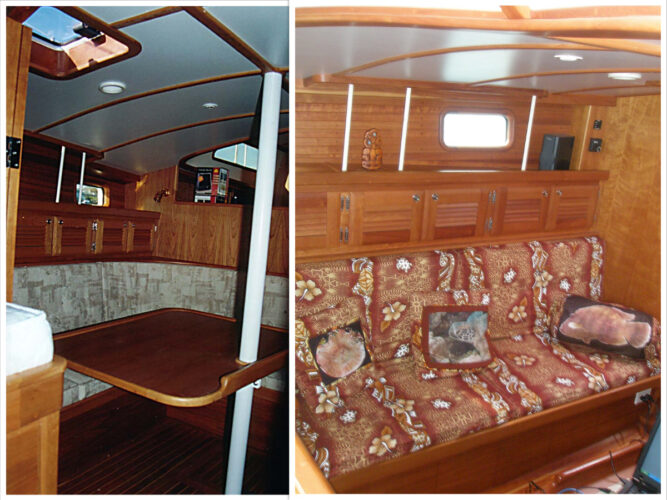
Left: Our original upholstery on Traversay III; Right: The Tahitian Look in the salon
We loved the Tahaitian Look, but the shiny cotton started to wear badly, especially on corners. When we reached South Africa, I contacted an upholsterer with the hope of getting beautiful leather upholstery. She promised, but then broke her promise when the World ARC came in with customers paying three times the set price. I was quite discouraged, but when we went shopping I discovered a bonanza of wonderful African prints. I paid $140 CDN for material, zippers, thread and everything necessary to turn our salon into a masterpiece in stripes. We bought beautiful original art including the Three Graces carved from a single tree trunk and African prints for Duvet covers.
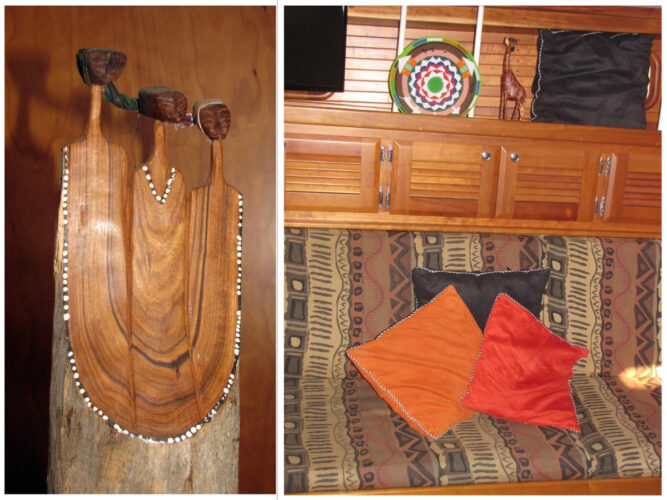
Left: Three Graces African art; Right: African stripes in the salon
The African Theme lasted very well. It was especially effective in keeping our spirits bright on our long traverses in cold climates – North of Norway to Svalbard and over the NW Passage.
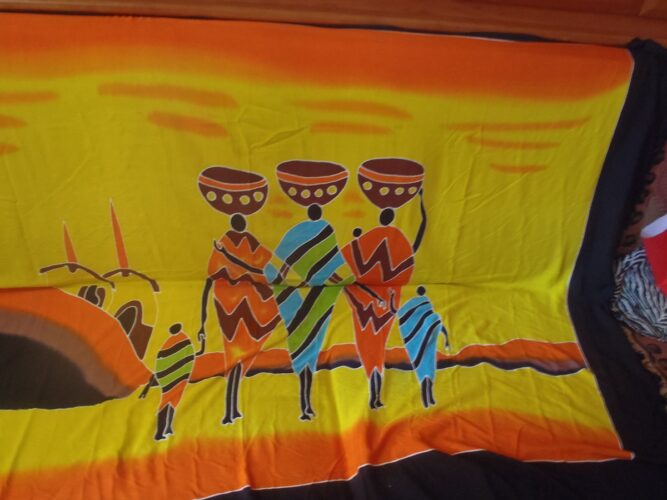
African-themed duvet cover
It was only after we’d been settled in Victoria for a few years that the upholstering bug struck me again. Here, we bought marine blue upholstery which sets off the red cherry furniture quite beautifully. We’re happy with this, and I have the feeling that the bug has finally been laid to rest!
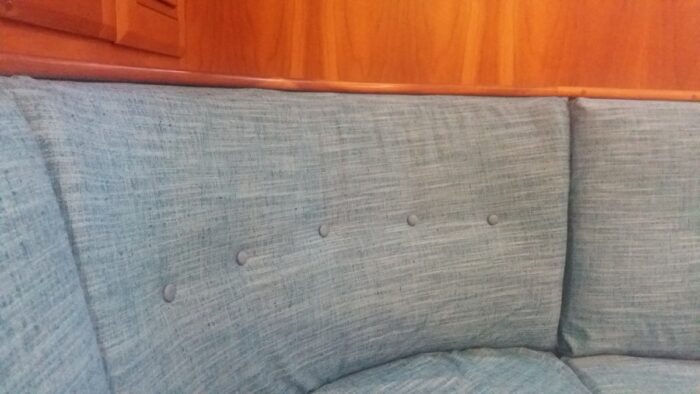
Our current BC upholstery
Having a good sewing machine on board has greatly contributed to our quality of cruising life by allowing us to not only make our own sail repairs, but also to beautify our living space.


 Currents PDFs

Wow! Mary Anne, I believe you are capable of anything you set your mind to. Bravo!
Beautiful creations – well done
Looks like your latest sewing machine is more portable than our Sailrite. Beautiful results. Love the prints from South Africa. I missed out on visiting fabric shops in Capetown.
Hi Mary Anne
So wonderful to see your sewing talent put to practical use! Ji, and I would love to hear from you.
Love
Linda