

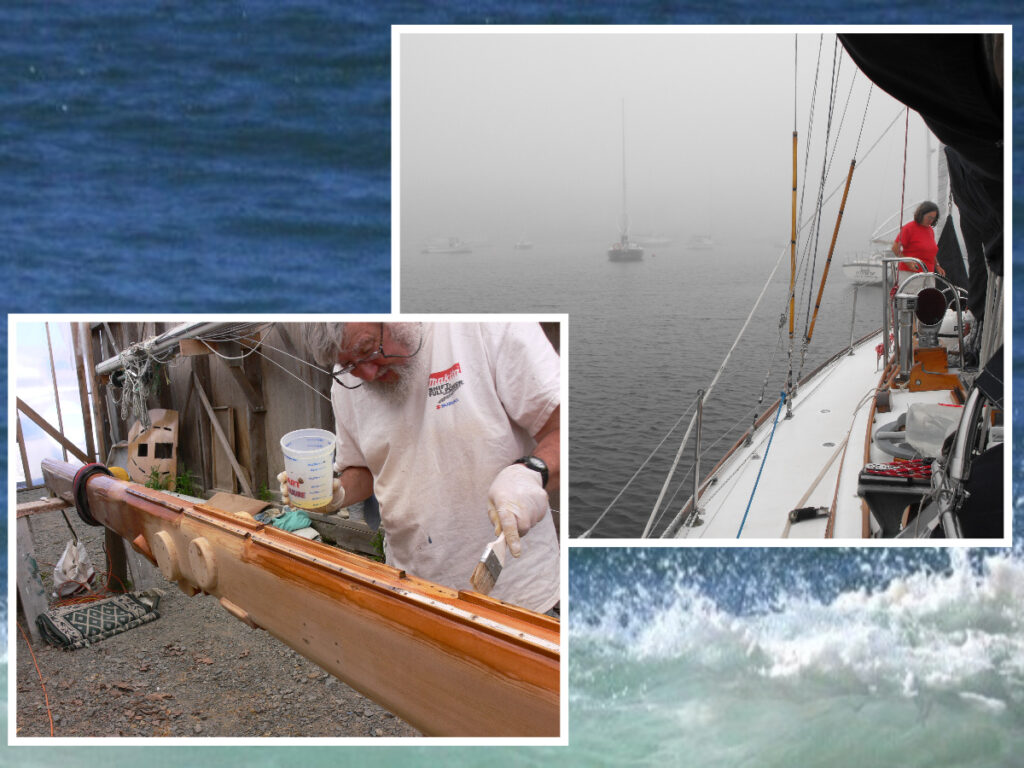
On August 30, 2025, Practical Sailor, the Consumer Reports of sailing, published a video called Top 5 Reasons NOT to Live on a Sailboat. The aim was not to put you off living on a boat, but to encourage you to take time to assess what living on a boat means before you take any irrevocable steps.
In summary, the five reasons Practical Sailor lists are these:
- Everything breaks constantly.
- Boats are expensive to buy, to maintain, and to dock.
- Boats force you to make compromises for daily comforts, such as having a car, reliable internet, and hot showers.
- Cooking and sleeping are harder on boats.
- Your life revolves around weather.
We, Stephen and I, spent 15 years on Fairwyn, a 42-foot wooden S&S yawl built in Scotland in 1957. We crossed the Atlantic twice, once in 2008 from Chester, NS, to the Azores, and again in 2013, from the Canary Islands to Antigua. On both Atlantic crossings, our friend Chris Boulsbee travelled with us. Having lived on a boat for all of those years, I can agree with Practical Sailor’s cautions. However, I don’t regret a minute of those years.
Here are how the five reasons worked out for Fairwyn.
1. Everything Breaks Constantly
Yes, we had lots of breakage. The alternator quit in the middle of a calm in the Gulf of Panama. Stephen replaced it with a spare as I slowly tacked back and forth with only the genoa. He stupidly kept his watch on while doing the work and ended up with the stainless steel band seriously burning his wrist when it encountered a hot wire.
Other electrical problems kept us in Bahia Caracas in Ecuador, so we almost missed our haul-out date in Santa Lucia further down the coast.
Our autopilot quit just one day out of Tenerife at the beginning of our passage to Antigua. Three of us hand-steered for 21 days.
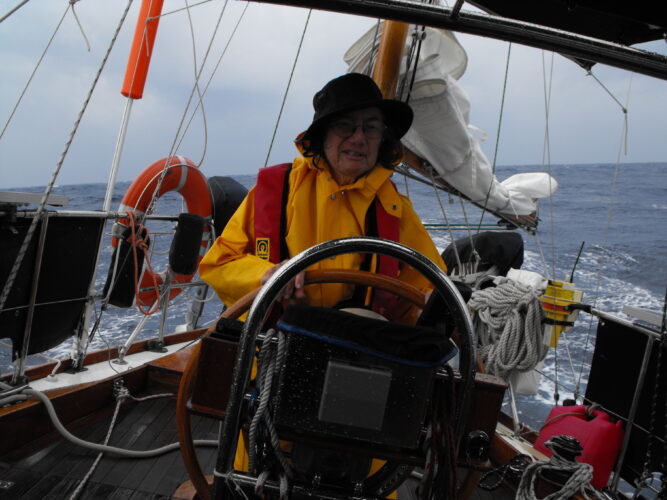
Nancy hand-steering
When we arrived in Antigua, we managed to get the autopilot repaired because the motor was full of carbon. As other people have noted, it’s always good to know how to repair things that go wrong at sea!
At one point, we discovered a leak in one of our under-berth 35-gallon water tanks. Actually, that proved not very difficult to fix because the tank could be disconnected and the leak made available without our having to take the tank out of the boat. Water in those tanks was always potable. We did put the water through filters when we put more in the tanks. The tanks were usually connected, but when we were heading upwind and heeling we disconnected them to ensure that the water in the tank on the windward side did not overfill the lee side.
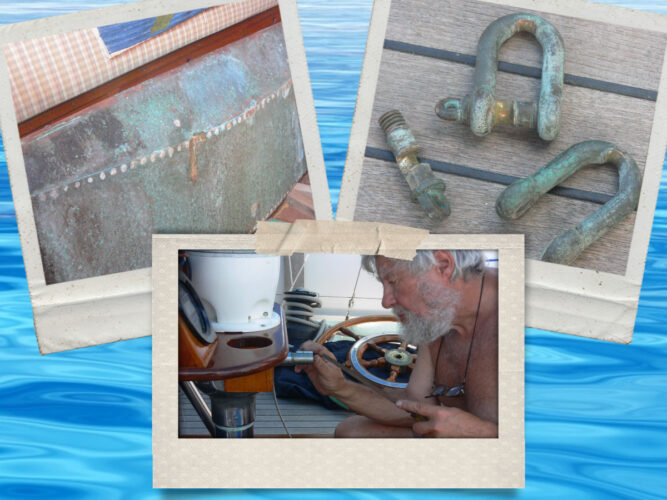
Top left: leaky water tank; Top right: wear on shackles; Bottom: Stephen repairing the key in the steering wheel.
2. Expense
Before we set off in 1998, we wanted to race to Hawaii in the Vic-Maui race. However, Surveyor Ken Rorrison discovered rot behind the bronze strapping of the hull: we could have been certified for coastal cruising, but not to go offshore. We also could have replaced the planking just under the straps, but that would have made the hull very ugly. Instead, we opted to have the entire double-planked hull beneath the waterline replaced.
We had a party to celebrate the last plank, including Scotch, of course, because Fairwyn was built in Scotland.
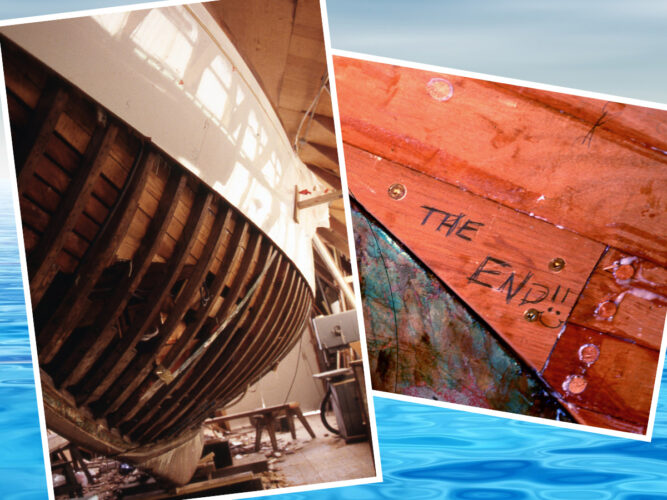
Left: Stripping the old double-planking, with one of the bronze strappings hanging down; Right: the End Plank of the boat.
The cost was more than we paid for the boat in the first place in 1982, but the boat ended up with a beautiful hull and we were cleared for offshore sailing.
Moorage
Knowing moorage is expensive, once we began our supposedly five-year cruise (turned out to be 15 years) in 1999, we tried to anchor as much as we could to avoid paying for moorage. Anchoring worked off and on in California, in the Caribbean, on the east coast of the US, and in the Maritimes and Newfoundland. In Mexico we mainly anchored except during the summer in Puerto Vallarta and Colima, when we left the boat on its own.
We anchored in most of Central America, Ecuador, and the Galapagos. In Panama, we took a mooring off the Panama City Yacht Club, which is no longer in existence.
We paid the most for moorage in the Mediterranean, where it turns out that no one cruises in the winter because there is either no wind or too much wind. We were in marinas one winter in Sardinia, two winters in Malta, and one winter in Sicily. Winter fees were reasonable, though fees in the same marinas in summer were outrageous. We found places to anchor in the Mediterranean in summer, though some bays that looked good on the charts had buoyed swim areas which meant we had to anchor further out with less protection.
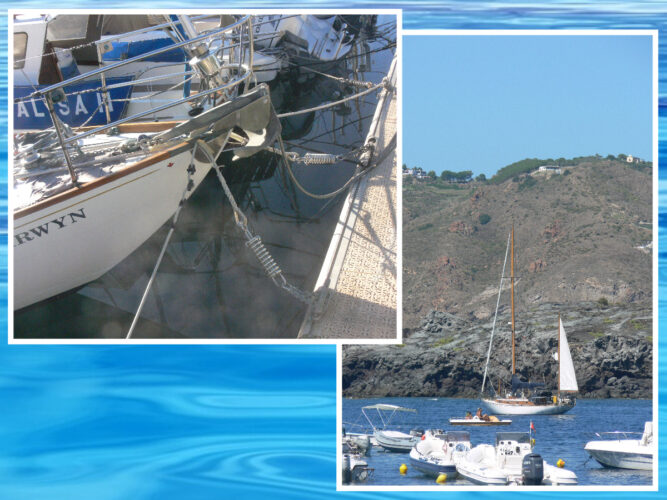
Left: Triple moorings in Malta during an Adriatic winter storm that came right into the Manuel Island marina; Right: Isola Vulcano, north of Sicily – keeping costs down by anchoring out.
Haul-outs
Most of the time we did fairly quick haul-outs to paint the bottom and change zincs. However, in Nova Scotia, we spent some time on the hard preparing for crossing the Atlantic. We took both masts out for sanding and re-varnishing.
In Gold River, the bronze manufactured centreboard came out to have the screws tightened or replaced. Five years later, that centreboard broke off when we were re-crossing the Atlantic; it was not replaced until we arrived back in BC.
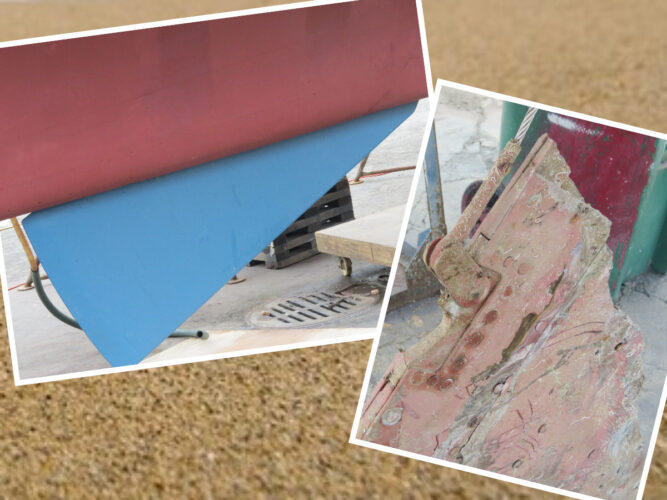
Left: New centreboard made of fibreglass with lead inserted by Eric Jespersen in 2015; Right: the old metal centreboard after it was removed from the boat in Florida in 2014 after we had crossed the Atlantic.
3. Compromises for Daily Comforts
Yes, we had no car to run errands from wherever the boat was anchored or moored. We used a cart to provision and get fuel if there was no fuel dock. We could get three 20-litre yellow Diesel tanks on the cart at once. In Cartagena, Columbia, Stephen hired a taxi to take him to all the marine supply and tool places.
Fairwyn has no shower, so we managed with what my mother used to call sponge baths, sun showers in warm weather, and lovely hot showers in marinas. Stephen was known to leave his shampoo bottle in marina showers, so he was “required” to take a small amount in an old pill bottle so it didn’t matter if he forgot to bring it back to the boat.
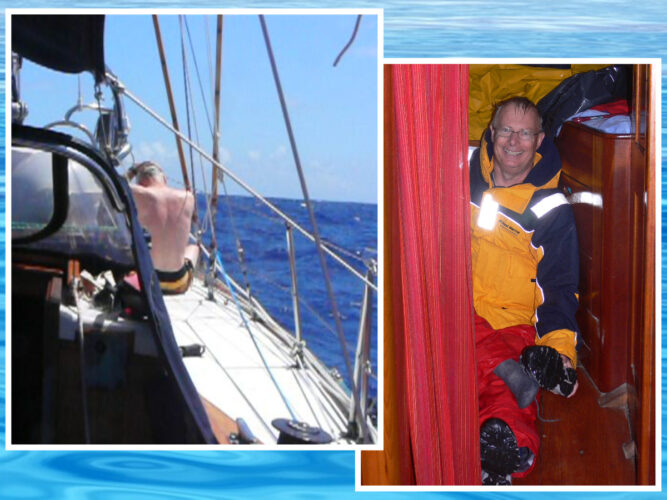
Left: Chris showering on the deck while crossing the Atlantic; Right: Chris on the cabin sole in the forward cabin, working on getting his foul weather gear on.
For communication, we used VHF, SSB, Sailmail, and shore-based internet—long before today’s availability of onboard connections. The only time that was a problem was when my university roommate died and I did not know about it until we landed in Los Angeles and found out that the funeral had already occurred.
4. Cooking and Sleeping
We had a kerosene three-burner stove with an oven. Although it required pre-heating with alcohol, it worked very well, including for baking bread. At times we considered changing the stove to propane, but that would have required reconstruction of a lazarette to create a locker with outboard ventilation. Instead, we had a copper kerosene tank in the cockpit locker attached to the stove that did not require filling very often through a deck pipe. And we found that kerosene was available everywhere – although this is perhaps not true today. (Note: the new owner of Fairwyn [since 2017], Richard Leland, did turn a lazarette into a propane locker and installed a propane stove.)
To make meals easy to eat at sea, I served them in what were originally Scandinavian water scoops, bowls with handles that you could hold in one hand while you ate with the other.
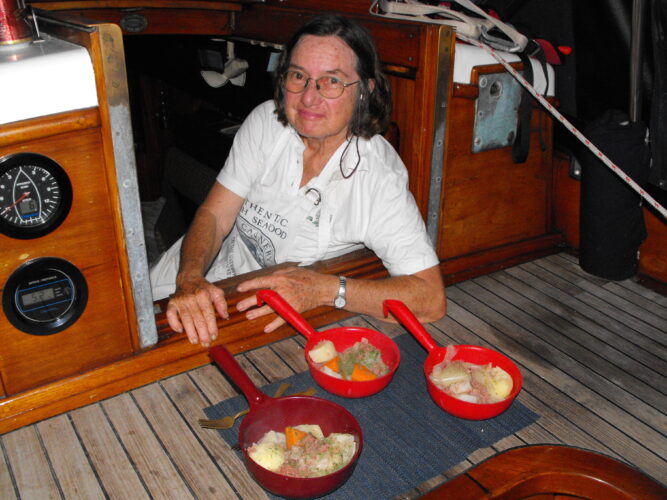
Another gourmet meal served in Scandinavian water scoop bowls – Stephen’s without the carrots. (Photo by Chris Boulsbee.)
At anchor we slept in the V-berth, but, at sea we slept in the main cabin berths that had both leeboards and attached lee cloths that prevented falling out. When three of us were aboard for long passages, we hot-bunked.
In hot areas, we could open hatches and portlights because they had screens to prevent insect access. We also had small electric fans above our berths. Because Fairwyn is a wooden boat, it did not suffer from condensation.
5. Life Revolves Around the Weather
Yes, it definitely does. We never gave friends who planned to visit us on the boat a date when we would be at a specific place. Instead, we said we would let them know when we have arrived at Acapulco or Siracusa or Cartagena, and then they could make plans to join us. Obviously, that meant that friends could not take advantage of cheap airfares bought a long time in advance, but we could never guarantee when we might arrive at a destination.
We postponed our departure to cross the Atlantic from Chester, NS, twice to avoid the tropical storms related to Atlantic hurricanes in July 2008, and again when fog enclosed the harbour.
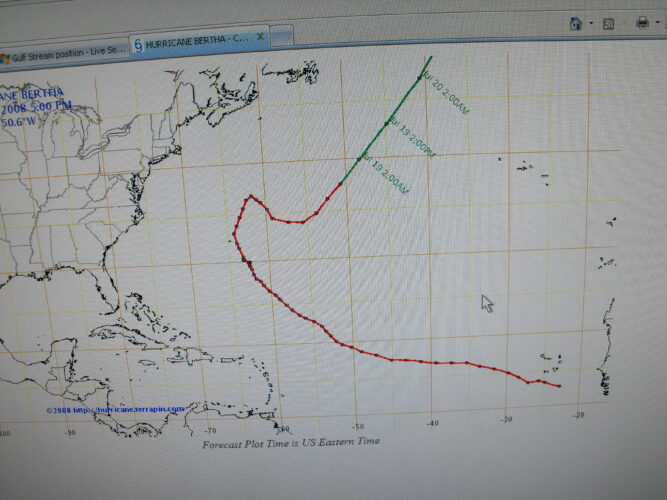
Tracking hurricane Bertha in July 2008
We always paid attention to weather forecasts and local knowledge and never left a safe anchorage or marina if bad weather threatened. On the night before we intended to enter the Rio Dulce in Guatemala, we were anchored in a bay across from the entrance. During dinner, a westerly wind came up making the anchorage dangerous. We pulled up the anchor and motored into a nearby sheltered bay to re-anchor and postpone our river entrance for a day until the wind subsided.
And even in Sicily, in the summer time, we once had a hail storm in May.
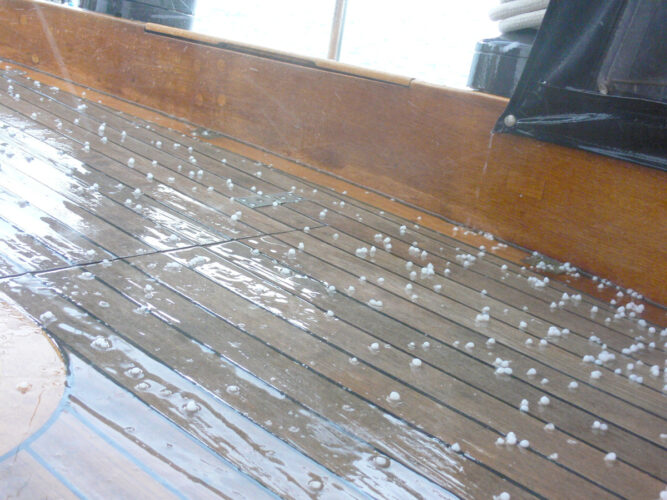
Hail on the deck in Sicily
So, even though there are many new ways of communicating now, you still have to pay full attention to the weather: starting early, rescheduling, postponing, and never telling visitors when you will meet them until you are where you plan to be.
That is how Fairwyn coped with Practical Sailor‘s reasons for not living on a boat. Although we had some challenges, we had no regrets.


 Currents PDFs


Comments