

Swing Room? What’s that? After leaving the mid-coast of BC behind, we dropped our last hook in Goose Bay anchorage with about 400 feet of swing room in 20 feet of flat mud bottom.
The morning brought flat calm seas as we motored into Hakai Pass and Pruth Bay in bright sunshine. The half dozen boats on anchor had left us space on the front row, directly in front of the dock in 25 feet. After checking with our neighbours for their anchor locations and length of chain/rode out (which averaged about 100 feet), we dropped anchor and settled in as a few more boats arrived, making it a dozen or so for the night.
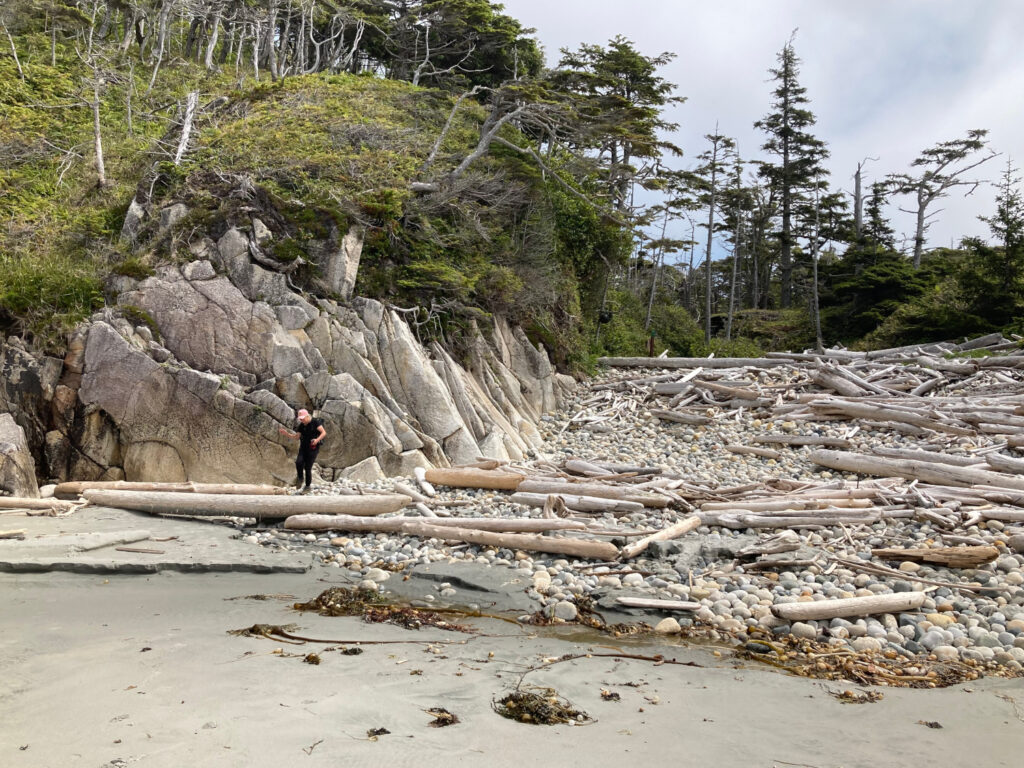
In the morning, we hiked the seven beaches (not seven seas), including the lookout, over light fog. I stood on top and swung my arms, happy to have swing room. Leslie had been smiling giddily all day as she took pictures of about a hundred different islands, beaches, and flowers. The large swell in stormy seas left piles of logs on the beach stacked high (see above photo) but which don’t show on charts; it’s worth noting that such logs can limit swing room on exposed anchorages as well as in some bays.
We launched our kayaks from the high tide beach and paddled back to the boat, where our neighbours were all in a kerfuffle about another late arrival who had dragged across the entire bay, over everyone’s anchor. At first we were clear of the mess, so we sat back to watch. Our immediate neighbours began to untangle themselves from a third boat that had dropped on top of their anchor. Great entertainment on a sunny afternoon after a long hike.
Soon that third culprit drifted at us, about to T-bone our bow. Since no one was on board, I fended off and decided just to raft him to us to prevent further spaghetti. The other two boats finally untangled each other as the culprit arrived on their dinghy, back from their hike, to find themselves rafted to us. Inquisitively, they asked what was happening.
We explained that they had been observed by others, drifting across the whole bay over everyone’s anchor lines. They clarified that they were only backing up to set their anchor. So I asked: “How much chain did your have out?” About 210 feet they replied. In 25 feet, I thought it seemed excessive. “Ever heard of swing room?” I thought to myself, politely biting my tongue. They had only drifted alongside, so they were able to use their dinghy to pull us away and around in front, to sit us over top of our 15 kg Rocna anchor, which had gone in solidly on full reverse in 25 (+-8) feet of mud the day before. We had left out 120 feet of chain and rode, expecting to have to pull it in later as the tide and wind dropped; we made sure to be back aboard before the crowds arrived.
Some 16 boats showed up and filled the bay. Another two boats had dropped within our swing room, including the one that was complaining and untangling another late arrival. All acknowledged that they had dropped a bit close to us, and either pulled in some chain or reset at the outer edge of the bay, leaving with apologies and shame.
I explained to our closest neighbour that we had all been there at one time in our boating careers, and had patience with watching the learning experience about swing room. Since Navionics became the standard, we have learned to approach a crowded anchorage by sailing close by those parked close to our hoped-for drop spot and asking how much chain/rode they have out, and in what direction. Most explain that they are just sitting on a pile of chain and shouldn’t move far. After altering course at their bow to mark their spot, we use Navionics calipers to gauge their swing room from our best guess of where their anchor is, and then find a spot free and clear without overlap. Many seem to just assume a Venn diagram with expected overlap, and that we should all swing to the same tune and tide, and dance in unison. I had observed the night before that the flood tide swirled counterclockwise in the bay, and with the light breeze boats were all askew; like beginners learning to dance, they were fouled everywhere.
We waited for most boats to clear out in the morning and headed across to Adenbrooke Island and Fish Egg Inlet. We had anchored there before and found it a beautiful, calm spot, with multiple potential bays to drop into. After scouting a few of these and finding the bottoms full of boulders and steep 30-foot drops and hills, we gave up and headed back to Green Island, to a spot that we know well, and will hold a few boats late in the day.
On arrival, we found that four others had taken the best spots so swing room was too tight for our favourite spots. We crawled into the shallows with a few feet to spare on all sides, with just enough swing room for a close waltz, but not enough to dance so as to fill an empty ballroom. Oh, I long for swing room, an empty ballroom, and a dance partner to swing with. We managed the tight spot for the night and slipped off in late morning to Millbrook Cove to get an early start on rounding Cape Caution.
Unfortunately, another southerly was forming for the following day. The hard rule for rounding the Cape is to wait for a SE going north or NW going south. With winds over tide, the Cape can get a bit rough. We got to Millbrook Cove well before happy hour to find a dozen or so boats all settled in, and no swing room to spare. A couple of them recognized us from recent anchorages as our red boat is quite distinctive.
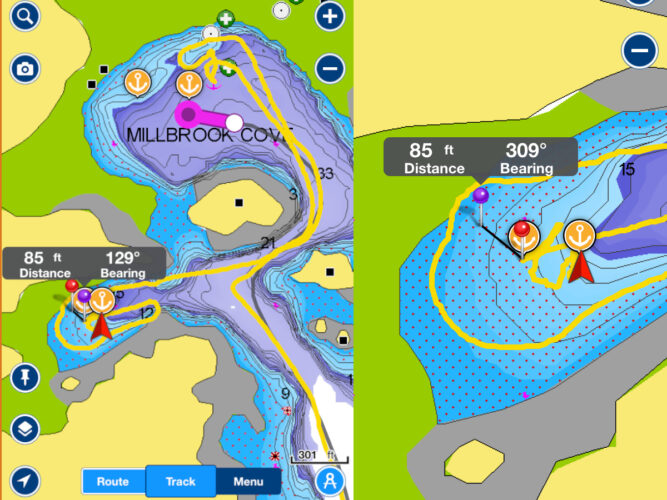
We scouted the edges of the bay to confirm just how close we could swing towards the shore safely. Using calipers on the chart, we clarified distances from other boats’ swing room and from reefs or rocks.
Once we had mapped and measured our last hope for swing room, we found the dance would be too tight and departed with a wave, indicating it was too tight for us. They all look relieved that we left. As we did a couple of sharp turns out the cove entrance, Leslie asked: “What about over there?” I looked quickly and said it was too shallow and tight, and we would have to look elsewhere. On her insistence I agreed for a quick look, and we entered the outer bay that indicated just 12 feet in the middle. We drove around the edge at the ten-foot depth line to check it out. We had eight feet of tide now, dropping to a one-foot low at 7:30 AM. Our depths are measured from the bottom of the keel, so that would leave us a few inches on the edges of the bay with almost 200 feet of swing room overnight. That’s larger than a ballroom, so dance solo we did.
After pacing off the edges, swing room, and depths, we dropped in the very centre in 13.5 feet under the keel on a flat mud bottom. Then, setting our Rocna and ramping up to full reverse power, we pulled in some rode and left just 93 feet out. That should give us about a boat length on all sides. We watched over dinner as we swung before settling in for the night.
I set my alarm for 0500, first light. Two hours before the less than one-foot low tide, we would have a healthy five feet below our keel.
Following a calm night, the anchor was easier than usual to manually haul from that shallow depth. Now we were free a couple of hours before lower low tide, as planned. We were able to get around Cape Caution at slack and before the low westerly swells grew with the afternoon winds to toss us about as if it was a lively jive dance, flooding us into the fog at Pine Island. We had had enough jiving coming south of the Cape, we expect tight anchorages, a bumpy crowd, and no swing room. One year, our first stop to anchor south of the Cape was in Squirrel Cove, with over 100 boats at anchor. After 3 months on the mid-coast, it was a shock to the system.
Tonight, I will dream of swing room, a shallow mud bottom, trees all around, and calm winds, remembering to plot my and others’ swing room before starting to dance.


 Currents PDFs

100 boats in Squirrel Cove?! Wow!