

[Editor’s note: this article is the second half of a longer piece about Gibraltar. The authors had arrived in Gibraltar as part of the crew aboard La Magona del Mare. The first half describes their observations of the town of Gibraltar, while the following article focuses on the many sights of the Gibraltar Nature Reserve Park. See part 1, “Gibraltar – Around the Town.]
The Gibraltar Nature Reserve Park was a highlight of our visit and well-worth the approximately $35 CAD day-fee.
Moorish Castle
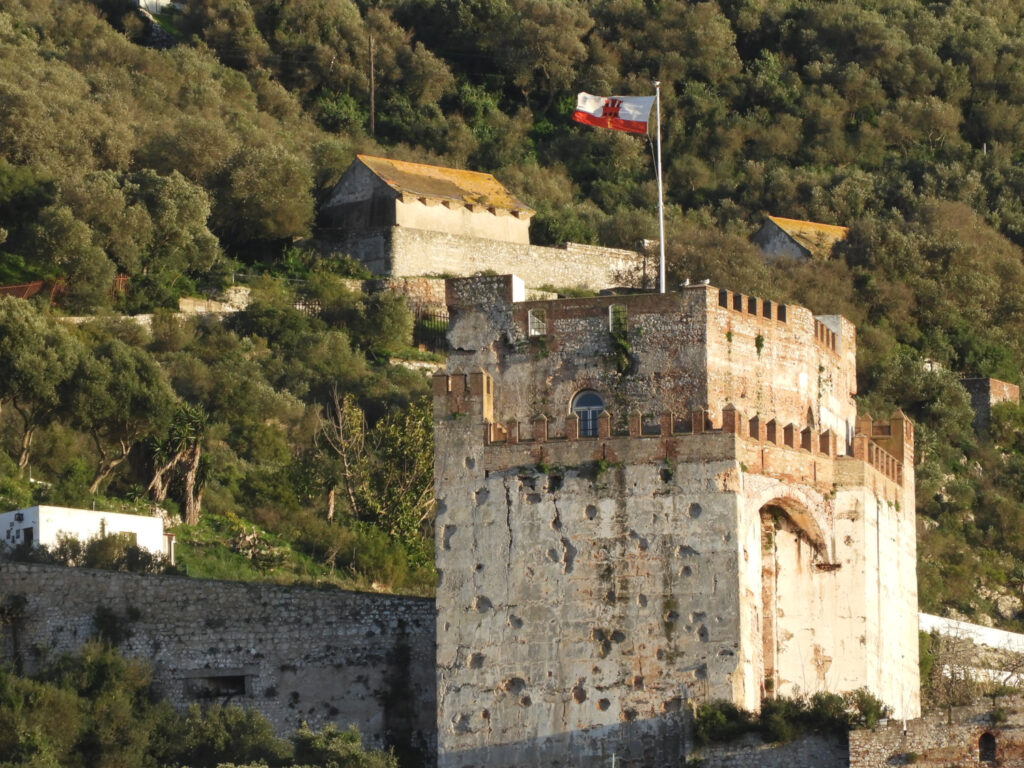
We began our self-guided exploration at the medieval Moorish Castle. Construction of the castle began in the 8th century during the first Moorish occupation (711-1309). After the Moors returned in 1333 (until 1462) the castle took on its present form. The Homage Tower is one of the most noticeable parts of the castle, sitting quite prominently on the hillside; its strategic location allowed one to see all movements in the bay and through the Strait of Gibraltar. At night, colourful lights are sometimes projected on it. We went inside the tower – the walls were 3 m thick! Definitely built to last. The Tower was not a place of luxury accommodation but rather a refuge where the Islamic Governor could retreat to in the event of a siege.

Entrance to Homage Tower, with crewmate Chris
WWII Tunnels
Just a short way up the hill from the Moorish castle are the WWII Tunnels, all 34 miles of them! During the war, the tunnels were housing about 16,000 men at times, all out of sight of potential enemies. Information signs and dioramas demonstrated some of the amenities of the place, including a bakery, barracks, offices, sick bays, and a radio room. There was a large generator, enough food stored for 16 months, and of course, storage for munitions. Our patriotic selves were interested to read that many of the tunnels were dug by Canadians, who were brought in for their expertise dealing with very hard rock. The rubble from the quarrying was used to extend the airfield runway.

Top Left: Sign describing the contributions of the Royal Canadian Engineers; Top Right: WWII tunnel; Bottom Left: Crossroad in the Tunnels; Bottom Right: Barracks with diorama
Great Siege Tunnels
The Great Siege (1779-83) occurred when Spain and France joined forces in an attempt to wrest control of this area from Britain. The two countries had hoped to to take advantage of Britain’s strained resources during the American Revolution. If you like tales about underdogs holding out with grit and determination, the story about the Great Siege is a good one. A small British garrison of about 5,000 people held out for 4 years, under dreadful conditions, against much greater forces. At one point, as many as 65,000 attackers (during the Grand Attack) still could not take the Rock away from the plucky Brits. Not to diminish the courage, resourcefulness and tenacity of most, it seems fair to note that some of that persistence was enforced by a Governor who was determined to defend the fortress at all costs, and with strict and brutal discipline: “deserters were usually hanged or had the letter D either tattooed on their forehead or branded on their forearm” (from a Ministry of Heritage Information sign).

Some of the punishments decreed by Governors
Although Gibraltar has incredible defensive characteristics, there was an area on the north-east side of the rock which was unprotected. It was desired to place a gun there to cover this blind area where the enemy could approach, but the spot was inaccessible due to the vertical cliff face. The tunnels were dug out in order to reach that area through the rock. Along the way, and with various false turns before the main destination was reached, more tunnels were made and more cannons were placed, improving the defensive capabilities of the garrison. The tunnels were not as spacious as the WWII tunnels, but a very impressive and effective network nonetheless, especially when one remembers that, although some gunpowder was used, the tunnels were mainly dug out by hand by a small group of men.
Barbary Macaques and Charles V Wall
A delightful experience for us was seeing the Barbary macaques. They are wild creatures and can be unpredictable and dangerous; signs warned of how to behave so as to avoid antagonizing them. We came upon a group of them hanging around the Charles V wall. The wall was built in 1552, during the reign of Charles V, in response to a 1540 attack by Turkish pirates, lead by Barbarossa. We wanted to ascend the steep stairs along the wall to reach the top of the Rock but were concerned about getting too close to the monkeys. Finally, after most had moved away we decided to risk it – speaking softly in what we hoped were soothing tones, we stepped cautiously past a couple of stationary monkeys who, to our relief, seemed quite indifferent to us. For those not keen on stairs, there was a cable car one could take from farther down the hill. Both led to the top where there was an impressive view and O’Hara’s Battery was situated, with a range of 16 miles – enough to reach the coast of Africa. There were also several more macaques – these ones getting into mischief by climbing on a shuttle van that was trying to move through the crowd of people.
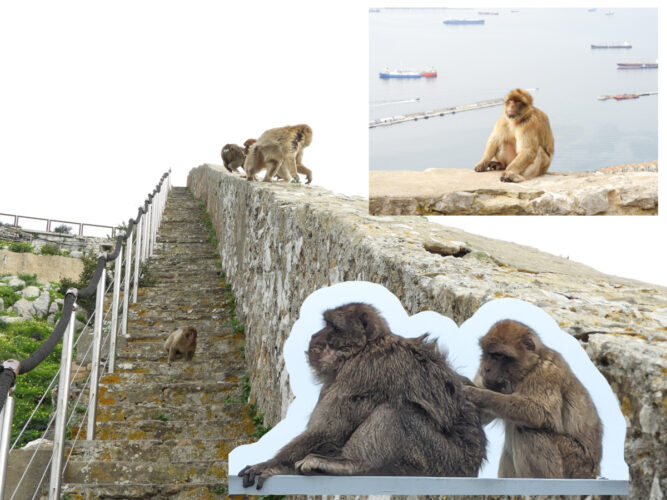
Barbary Macaques on the Charles V Wall, and other areas of the Nature Reserve Park
St Micheal’s Cave
St Micheal’s Cave was nothing short of awe-inspiring. This natural cave had incredible and extensive stalagmites and stalactites, many of which were highlighted with changing colourful lights. One stalagmite had been sliced through and polished, revealing the layering of minerals as the structure was built up over the years – a bit like a tree trunk but with a more random pattern. It was quite lovely. The cave’s name arose from the area in which the natural formations took the shape of an angel with outstretched wings. Colourful lights were set up to accentuate the angel aspects. Before St. Micheal was observed, some ancient Greeks thought the cave was an entrance to Hades and others thought it was a temple to Hercules.

Impressive natural formation (we estimate 60 feet high) giving the appearance of an angel with widespread wings
A movie/light-show was projected onto the walls and ceiling of one of the caverns; as we watched how powerful forces of nature formed our surroundings, our experience became more immersive as drops of water landed on us. Fortunately, the show was only 4 minutes long so we weren’t at risk of becoming stalagmites!
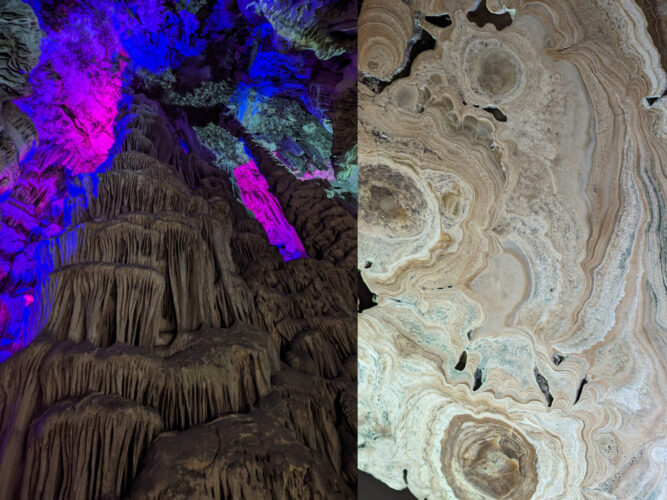
Left: a small portion of St. Micheal’s Cave, illuminated by changing colours; Right: Polished cross- section of a stalagmite
Final Thought
While our journey across the Atlantic did not come to pass (due to some family matters for the Captain), we feel fortunate to have had the opportunity to explore this fascinating area.


 Currents PDFs

Comments