

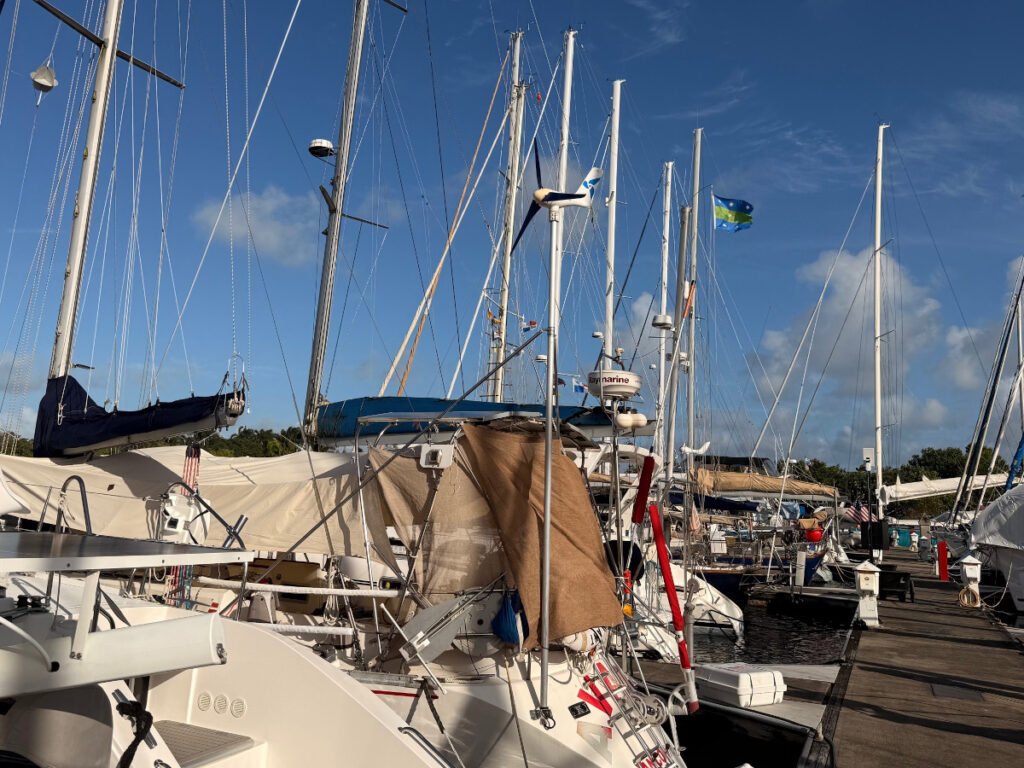
If you’re a cruiser who has ever stared sadly at your battery monitor thinking, “Please sir, I want some more” like some cruising Oliver Twist, then renewable energy is your best friend. Solar panels are the cool, quiet, hardworking kid in class — everyone loves them. But wind generators? They’re like that strange uncle who shows up unannounced, eats the steaks from the freezer, makes a racket, and then cleans the kitchen and washes the floor while you’re asleep. Let’s dive into whether you really want this noisy relative aboard, or if you’re better off sticking with solar and calling it a day.
Cost Per Watt: Wind vs. Solar (Spoiler: Solar Wins the Wallet War)
Let’s talk money, because nothing kills a dream faster than an empty bank account. A decent marine wind generator (say 400–500W rated) will set you back $1,800–$3,500, plus another $500–$1,000 to mount it. That’s roughly $5–$9 per rated watt. (Pricing varies by supplier, and finding a used unit can save you a bunch. But still, ouch.)
Solar? In 2025–2026 prices, good marine-grade panels are $1–$2 per watt, and a full install lands around $2–$3 per watt. For the same cash as one wind genny, you could plaster your bimini, arch and lifelines with 800–1,500W of silent sunshine power. And in real life, that solar will pump out way more amp-hours on a sunny day than the wind turbine ever does, even in a howling breeze. Wind is like paying premium for a cat that only catches mice when it feels like it. Solar is the reliable feline that always shows up with the goods.
A real-life cruiser tale: Last year, a screaming deal popped up in the local WhatsApp for-sale group chat — a gently used Silentwind wind generator at a price that made our heart skip. Temptation level: maximum. The numbers said “more solar,” but we were maxed out on real estate and the Caribbean trades whispered “you’ll thank me later.” About 1/3 of the boats here have wind generators. We went for the wind genny, mounted it up, and holy amps, Batman — it’s been a game-changer in the windy Caribbean! That steady boost at night and through cloudy spells? Pure gold when the sun’s playing hide-and-seek in puffy tropical clouds. It’s enough to cover our Starlink use (which wasn’t in the energy budget a few short years ago). Batteries stay topped up, and we’ve got zero regrets. Sometimes that quirky uncle is exactly the family member you need on board.
Where Wind Power Works Best: The Trade Winds
Wind generators come alive in their special sweet spot: consistent, reliable breeze with a side of cloudy days. Enter the trade winds — those glorious easterlies between 10°–30° latitude (Caribbean milk run, Pacific puddle jump, South Atlantic dash). Here, where 15–25 knots blow like clockwork, day and night, wind power actually earns its keep. A solid 400W turbine can churn out 5–10 amps around the clock (120–240 Ah/day) or more, laughing at cloudy spells or midnight anchor watches while solar is napping.
High-latitude spots like Patagonia, Scandinavia, or New Zealand can also give wind the edge — overcast skies starve solar, but gales keep the blades spinning like they’re auditioning for promotion to a wind farm. And when you’re beating to windward or reaching hard? Apparent wind goes through the roof, and power output cubes with speed.
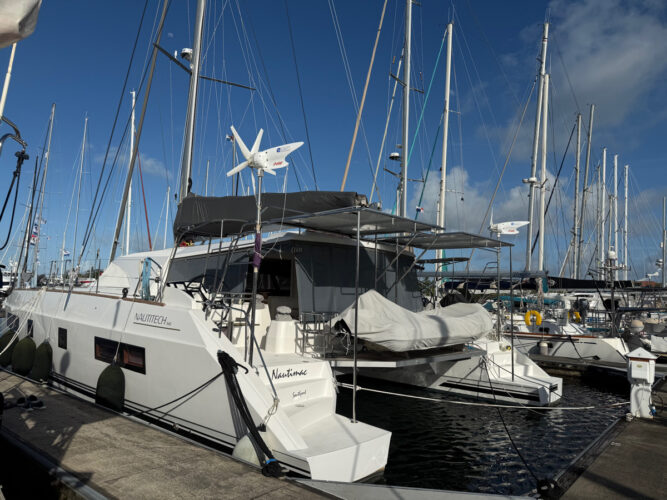
A catamaran with two wind generators — port and starboard.
Where Wind Power Disappoints: Pretty Much Everywhere Else
In most cruising grounds, wind generators are like that friend who promises to help move furniture but only shows up to drink the beer after you’re done.
Sheltered anchorages in the Pacific Northwest, Mediterranean, Bahamas, US East Coast, or anywhere with light/variable winds? Output drops to “meh” below 10 knots. Downwind passages (hello, trade wind oceans) kill apparent wind, so the turbine basically sulks until you’re at anchor and the apparent wind comes back up. And modern boats are floating solar farms — arches, biminis, davits, lifelines all covered in panels. And a wind genny and pole can shade part of your array, stealing more energy than it gives.
Then there’s the noise. Even the “quiet” ones hum, whine, or flutter in gusts, turning peaceful sundowners into “Did someone bring a swarm of angry bees?” Vibration rattles the rigging if you don’t get isolated mounts, and neighbors in marinas and tight anchorages give you the side-eye. But you will rapidly become deaf to the noise, sometimes even using the pitch to estimate the wind speed and amp output.
Noise Levels: Which Brands Won’t Make You the Anchorage Pariah?
Noise is the make-or-break for many cruisers. Here’s the lowdown on a few popular models we see here in the marina in Panama:
- D400 (Eclectic Energy): Often crowned the “strong silent type.” Basically background wind noise. You’ll barely notice it unless you’re trying to sleep right under the pole.
- Silentwind: Lives up to the name. Carbon fiber blades mean mostly a low, soothing rotor hum. Many call it the quietest in the fleet — perfect if you value your eardrums and neighborly relations.
- MarineKinetix MK4+ Marine Wind Generator: similar to the Silentwind. Looks like a good budget option.
- Superwind 350: Surprisingly hushed for its size. Sounds more like leaves rustling than a blender. Great if you want power without the drama. Startlingly expensive.
- Rutland 913 (Marlec): The six-blade wonder often wins quiet contests. Small rotor, low-wind focus — almost polite.
- Air Breeze (Primus): Stock version? Fluttery and loud in gusts — like a flock of startled birds. Upgrade to Silent-X carbon blades, though, and it transforms into a much better-behaved crew member.
- Ampair 100: Quiet little brother to the Rutland – small, unobtrusive, rarely complains.
- Chinese AliExpress units: We have met some cruisers that have had great luck with them, some that found the quality so poor they were disposable. Buyer beware.
Bottom line: If you’re going wind, pick one with fancy (blue) blades. All units dial up the noise in a breeze. Try to choose ‘quiet’ as a default characteristic. Otherwise, you risk becoming “that boat” everyone talks about on the morning net.
Maintenance
Unlike solar, wind generators have moving parts and can require maintenance. Most decent alternator shops can handle it, it’s just bearings, brushes and windings like an alternator. If a wind generator suddenly starts getting noisy, it’s likely bearings need replacing. Most go many years without as much as a second glance.
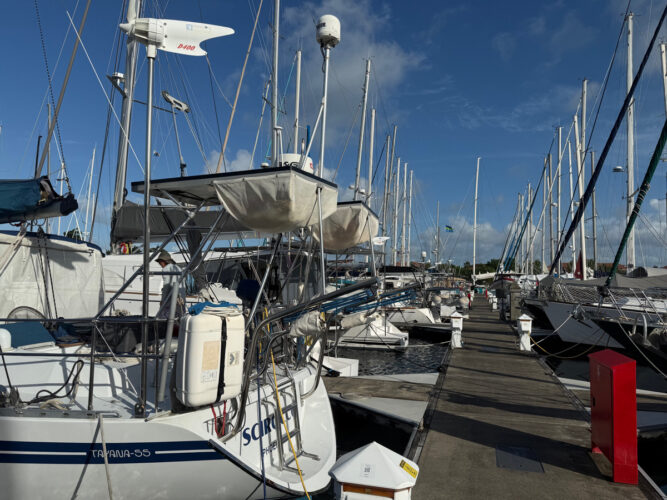
Wind generator setup on the stern of a sloop. Note safety string with loop hanging from the back. A bit hard to see in the distance down the dock, but about 35% of the boats here in Panama have a wind generator.
Safety Considerations: The Spinning Blades of Doom (With a Side of Ouch)
Let’s be real: those blades spin fast enough to make coleslaw out of anything that gets too close. The poster child for “don’t do this” is a 2023 incident on Good as Gold, a Montevideo 43 in the Whitsundays previously owned by BCA members Malcolm and Dina. New owner Duncan Veal, in 30+ knots, tried to stop the genny by yanking a cord (manual says use a boat hook). Hand slipped, blades said “hello,” and suddenly he’s got a shattered arm bone, deep cuts, a broken blade, and a one-way ticket to surgery. Months off sailing. Moral of the story: blades don’t negotiate. Always switch off, use appropriate tools, mount high and out of reach, and treat it like a table saw with wings. Complacency + user error = a very very bad day.
When to Add a Wind Generator (The Short List)
Go for it if:
- You’ve already maxed out your boat’s solar power potential. You’re full. No more room for panels. Really. Not even a little one.
- You’re doing serious trade-wind miles that will offer a reasonable apparent wind (Atlantic circle, Pacific crossing — wind is your night-shift worker).
- You’ve got a power generation /consumption mismatch (watermaker, fridge, Starlink, radar, etc. all want a bit more than you’re making) and you’ve already maxed solar real estate.
- You cruise cloudy/high-latitude zones where solar takes frequent siestas but the wind rarely rests.
- You love redundancy — wind plus solar is like having two alarm clocks.
When Not to Add One (The Even Shorter List)
Skip it if:
- You’ve got room for more (or better, or more efficient) solar panels.
- You’re in a sunny/light-wind paradise (PNW, Mediterranean, Bahamas — wind is just an expensive ornament).
- Silence and not losing fingers are top command priorities.
- You’re coastal/weekend cruising — engine or shore power has your back.
For most of us, 600–800W solar handles daily life without firing up the diesel. Wind is the cherry on top, not the cake. On Avant, we also like the idea of a backup to our solar. Hybrid systems are the smart play in our view, especially in windy Panama.
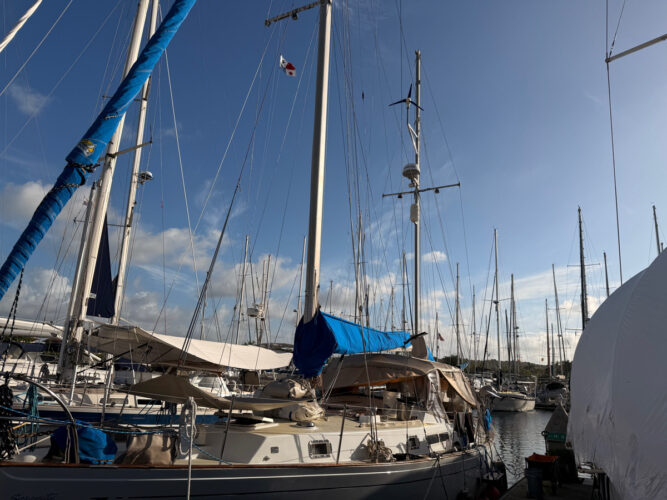
The G.O.A.T. (greatest of all time) mount for a wind vane, the mizzen of a ketch or yawl (up high and in clear air).
Final Thoughts
Wind generators aren’t dead, they’re just niche players. In the trades or windy latitudes, a good one (Silentwind, D400, Superwind) can feel like cheating: free amps while you sleep. Everywhere else? They’re often noisy, expensive decorations with a side of potential danger.
Do your energy audit, max out solar, double check that you really have maxed out solar, then decide if wind power’s cost and quirks are worth it. If you do add one (like we did on Avant), mount it high, respect the blades, and maybe get used to apologizing to the neighbors in advance. That’s the secret to true energy independence — without losing a finger or your sanity. Fair winds, quiet nights (mostly), and may your batteries always be full!
What power generation scheme are you using?


 Currents PDFs


Super (as usual) explanation of the costs, noise, and where in the world you might want a wind generator.
Thank you Rob for sharing this very helpful information on the various approaches to keeping the ship’s batteries charged up with solar and wind applications.
When I moored my 2o foot Flicka “SEA FEVER” in Point Roberts (before COVID) I had a 2′ square solar panel that could trickle charge both ship’s batteries year round without the need to ‘plug in’ to land power.
Since then it seems like the panels are larger and require regulators and more cables to produce the same result.
Between the sails and the solar panels and a small outboard the majority of the time “the ind and sun are our “oil” “.
Fair winds and following seas !!!
Blake Williams
SV SEA FEVER
Great article Rob. And timely. I am considering replacing my old Superwind 350 with a new unit. Solar real estate is maxed. Just went 5 days here in Fiji with virtually no sun but 25-30 kts of wind. Could have used 20-25A versus the 2.5 our old one churns out.