

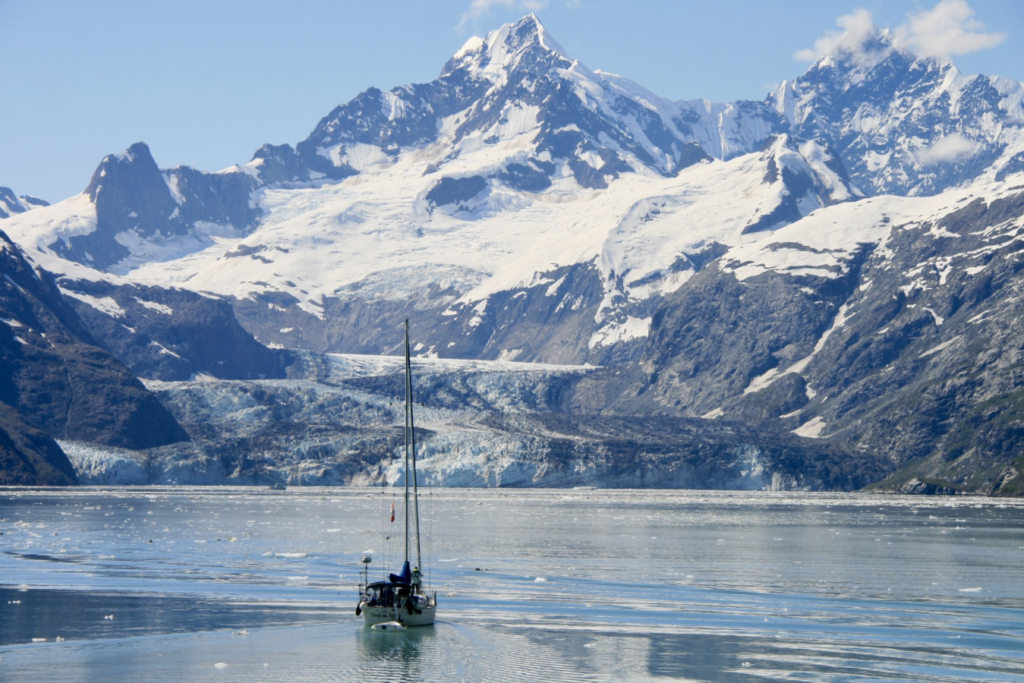
The thing about Glacier Bay that doesn’t fit neatly into a photograph is the scale. The mountains are very large. The glaciers are very blue. The water is very cold. And the history of the place — the fact that when Captain Vancouver sailed past in 1794 this entire 100-kilometre fjord system was buried under hundreds of metres of ice — sits over everything like a kind of geological vertigo.
We crossed Icy Strait on July 23rd in flat calm, threading through a sea of sea otters — dozens of them floating on their backs, pups resting on their mothers’ chests, entirely unconcerned by our passage. By evening we were anchored in Glacier Bay proper, inside the national park boundaries, a ranger having come aboard to collect our permit and brief us on bear protocol.
Going North
Glacier Bay is a National Park and the permit system controls traffic effectively. The result is a wilderness that actually feels like one. We spent three days working our way north through the fjord system, stopping at Reid Glacier, exploring side inlets, and generally behaving like people who couldn’t quite believe where they were.

59°02’N — the northernmost point of the voyage, Tarr Inlet, Glacier Bay
On July 26th we reached our northernmost point — 59 degrees, 2.535 minutes North — in Tarr Inlet, with the Margerie Glacier calving face ahead of us and the Grand Pacific Glacier beyond it. The sky was overcast. The ice was extraordinary. We stopped the engine and drifted for a while, eating lunch in the cockpit and watching the glaciers do what glaciers do.
Turning south from your northernmost point on a long voyage is a particular kind of moment. The mathematics of the journey change. Every mile from here is a mile closer to home. The passage shifts from adventure to return.
The Grizzly
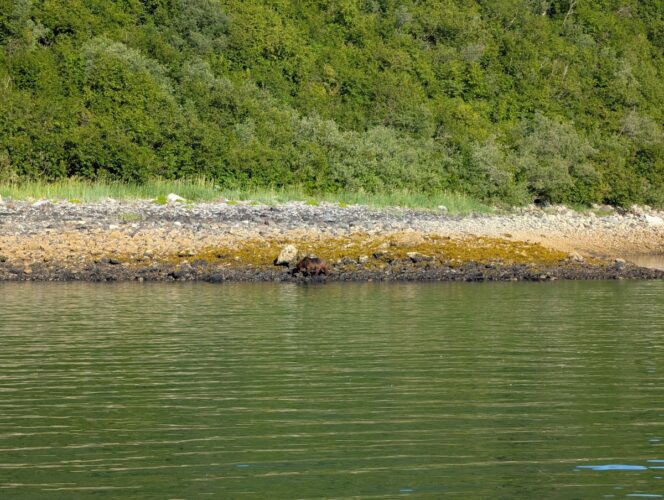
A grizzly bear works the beach at Blue Mouse Cove
Blue Mouse Cove, on the way back south, is the kind of anchorage that earns its reputation. Tucked behind a point in the lower bay, sheltered from most weather, with a beach that — we discovered — attracts wildlife.
We had barely set the hook when the crew of the boat next to us started waving and pointing toward the shore. A large grizzly bear was working the beach, turning over rocks methodically, looking for crabs. It was perhaps 200 metres away. It paid the small flotilla of anchored boats absolutely no attention.
We watched for an hour. The bear moved along the beach with that unhurried, powerful efficiency that large animals have when they’re doing exactly what they’re supposed to be doing in exactly the right place. Then it disappeared into the treeline.
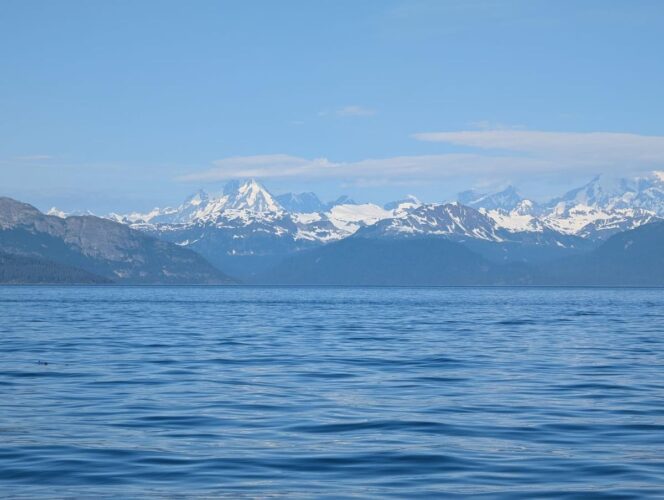
Leaving Glacier Bay: Heading South Toward Icy Strait and Hoonah
The morning we left Glacier Bay, the mountains were sharp in the early light and a pod of humpbacks was feeding in the narrows. We motored through them slowly, engine at idle, watching the great backs roll and the flukes lift on the sounding dives. Darrell and I didn’t say much. Sometimes there isn’t anything adequate to say.
Glacier Bay is why you sail to Alaska.


 Currents PDFs

Thank you for your evocative tribute to Glacier Bay. Bill and I sailed to Alaska in 1998, and got as far as Juneau before turning towards BC. We saw glaciers calving in Tracy Arm, Orcas on the hunt for seals, Humpbacks doing their best acrobatics. The beauty of Alaska was astounding and super-sized. We always planned to go back and explore more of the Alaska coast, but life sometimes happens when you’re making plans.
Again, thank you!
Thanks for your kind words
We loved so many places in Alaska. Will return one day!
Thank you for your awe-inspiring description of Glacier Bay. We have yet to get there, but we’ll look forward to it, perhaps when rounding our way back from the South Pacific.
Thanks Anne. Our tentative return plan is to head for sitka Alaska. We would love to revisit alaska. Its a very special place. Make sure your wet weather gear is solid and your heater works!