

“Pull harder! Harder!” the skipper bellowed. We were docking Mediterranean-style and my job was to secure the stern lines. Nursing a bad back, I answered “Stop shouting. I’m trying” He replied, “You can get off the boat now!” An apology from me and a handshake calmed the issue for now. I jumped ship a week later.
At a ripe 75, dreams of crossing oceans on my Cal 39 have faded, replaced by crewing. Four worldwide postings in the past few years.
The latest was a dreamy couple of weeks (I had planned a month) cruising the Greek islands aboard a fast 44-foot sloop. A video call with the British captain was amiable enough and I booked the flights: a long haul to Athens and a puddle jump to the isle of Leros. At the boat yard, I luckily missed two days of sweaty labour that my two crew companions endured, helping prepare the boat.

Parched and Sun-Drenched
The four of us sailed or motored one island per day. The skipper knew the choice spots, having explored Grecian waters for years. Each island had at least one good anchorage or public dock. We were sailing in the shoulder season of May, so space at each “parking lot” was usually available. The summer is jam-packed.
Docking, especially in a strong breeze, was a challenge. Drop anchor way out, with scope at least three to one, without crossing anchors. In reverse, squeeze between other boats before hitting the dock. Hopefully someone experienced will take your stern lines, but it’s rarely without drama. Lots of fenders are a must. Many ports charged only for water and electricity.
Each anchorage was picturesque with a few tavernas on the water with prices slightly higher than home (but no tipping). Few fresh fish on the menus, as the crystal-clear waters are barren. Very, very disheartening.
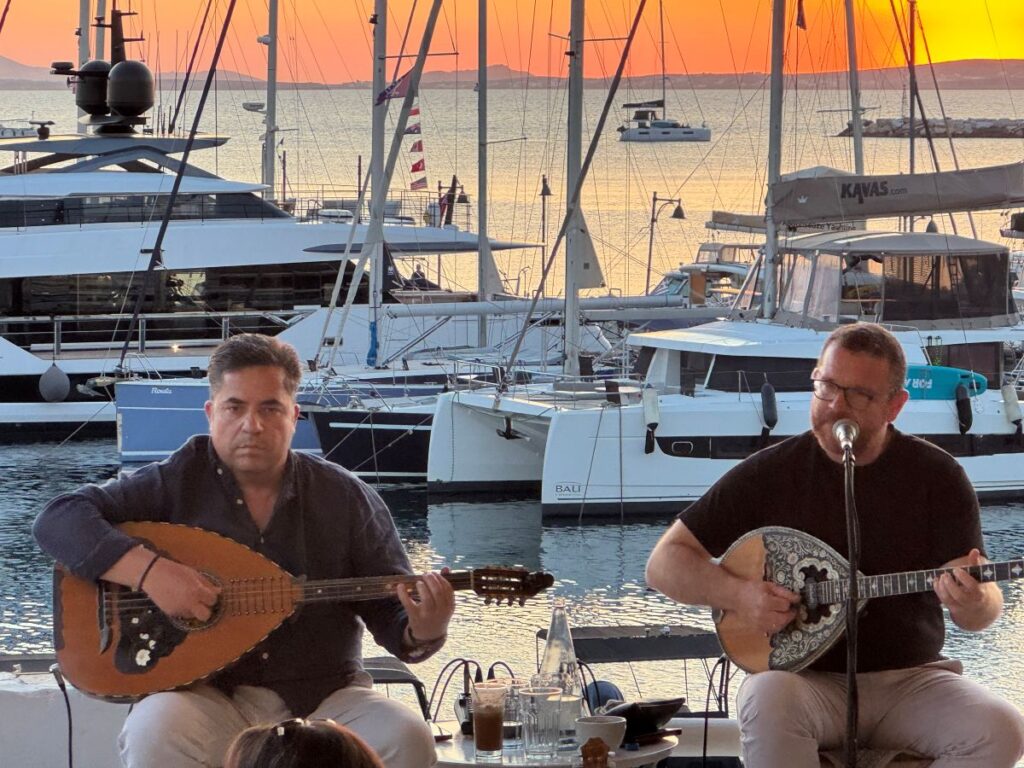
My favourite harbours were low key…no loud pop music or wall of condos. But we did catch a superb duo at a tourist restaurant before the dish-breaking ritual started (blame it on “Zorba The Greek”). Islands that have airports tend to be overrun with tourists. Few of us tried to speak Greek, which would have reduced the indifference locals show to the onslaught of foreign invaders.

Graffiti Everywhere
The boat was pristine and kept that way by a skilled and very picky captain. Sadly, he couldn’t control his anger. All three of us were on pins and needles. “Are we happy?” was his morning greeting. NOT! Two of us simultaneously jumped ship early. My replacement, a Canadian woman, lasted only four days.
What to learn? Sail your own boat or swap one as I’ve done several times. Your own boss for better or for worse.

Nafplio Old Quarter
If you do crew, have an escape plan with flexible air return and alternative travel plans. In my remaining days, I enjoyed strolling the old quarter of Nafplio with its nearby archeological sites, just a two-hour bus ride from Athens.
In hindsight, I did learn a few technical skills, such as using Johnson’s baby oil to clean windscreens. And I met kind, interesting crew members. A voyage soured by a captain who was a talented sailor but had delusions of being a nice guy.


 Currents PDFs


All about the captain, eh?
Nancy Carlman
Ian, an interesting comment. My wife and I have sailed among the Greek Islands and no doubt about it, Med Mooring can be a challenge. My wife and I created al least three arrival shows as we tried to Med Moor at various places as we made our way from Egypt to Gibraltar.
As to the social dynamics, we found that after our circumnav, chartering with a convivial group usually neighbours worked a lot better than a boat of unknowns. Yes, sometimes the dynamics were not entirely smooth but we never had any bailouts.
Thanks for sharing Ian! And your description of docking made me feel much better about by own some 25 years ago when I chose Greece (and Mediterranean docking) as mynforst ever charter experience! You article brought back (now humorous) memories of flailing arms as those already at anchor worried that my anchor would be directly on theirs!
Interesting to read a crew member’s judgment of a captain from the perspective of someone who is both a yacht owner and a skipper.
A raised voice from a captain does not necessarily mean anger or disrespect. It often reflects the urgency of the situation or simply the need to be heard by a new or inexperienced crew member. During docking, a captain’s primary concern is protecting the boat and ensuring the safety of everyone on board. In a tight Mediterranean-style docking manoeuvre, there is often no time for lengthy explanations.
On a well-run cruising yacht, commands are normally short, clear, and direct, consisting of three elements: what, where, and how. For example: “Mainsheet, port, ease!” These commands are designed to avoid confusion and allow the crew to react immediately.
Of course, it would be more polite to say, “Could you please ease the red line on the winch to your right by four inches?” But in a critical moment, clarity and speed take precedence over courtesy.
A captain also cannot be expected to know the physical limitations or experience of a crew member whom he or she has just met. Good communication before departure can help avoid misunderstandings.
That said, if a captain regularly bullies the crew, shouts without good reason, or creates an atmosphere of intimidation, it reveals poor leadership and a lack of respect. Such behaviour should not be tolerated.
In the end, there is a simple solution for those who prefer to make their own decisions and set the tone aboard:
Be your own captain.
Hi Ed, Thanks for your thoughtful perspective from a captain’s viewpoint. I was wrong to challenge his authority in a tense situation and hence my apology which was quickly accepted. But there was something amiss when all crew jumped ship weeks early, one reduced to tears after four days aboard. I think it’s impossible to find a perfect match, crew or skipper before you commit. (Lots of video chats help.) Hence the importance of escape routes for both parties. For crew, it’s Plan B with an open or flex air ticket.